

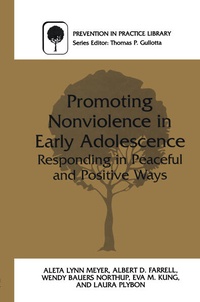
Promoting Nonviolence in Early Adolescence
Responding in Peaceful and Positive Ways
Published on 31. July 2000
Book
Hardback
XII, 128 pages
978-0-306-46385-3 (ISBN)
Description
In preparation for role-play during a RIPP class, 6th grade students consider the following conflict situation: Sharon and Josie, who are good friends, tryout for the basketball team. Josie makes the team, but Sharon does not. The week after tryouts, Sharon tries to pick a fight with Josie, calling her a "cheater" and "some one the coach felt sorry for. " Josie is in a bind; she wants to remain friends with Sharon, but she is really angry with Sharon for treating her so badly. What can Josie do in this situation? What type of self-talk will help her work out this prob lem with Sharon and keep the friendship? During the role-play, Sharon calls Josie a cheater. Then, before Josie re sponds, two students representing her positive and negative sides take turns whis pering into her ear. Negative self-talk: "Boy, is she a loser! What if everyone believes her and thinks that I cheated to get on the team?!" Positive self-talk: "I know I worked hard to get on the team! Sharon must really be hurt that she didn't make it. I can talk to her later when she's cooled down, and maybe we can do something together after practice. " Josie listens to the two voices, and decides that the best approach is to ignore Sharon's comments for now and to call her later that day to see if they can do something together. This description of students dealing with everyday conflicts is quite real.
Reviews / Votes
` ... it will provide interesting reading for school-based professionals concerned about reducing violence en conflict. 'READINGS, March 2001
More details
Series
Edition
2000 ed.
Language
English
Place of publication
New York
United States
Publishing group
Springer Science+Business Media
Target group
Professional and scholarly
Research
Product notice
Laminated cover
Illustrations
XII, 128 p.
Dimensions
Height: 234 mm
Width: 156 mm
Thickness: 10 mm
Weight
382 gr
ISBN-13
978-0-306-46385-3 (9780306463853)
DOI
10.1007/978-1-4615-4243-8
Schweitzer Classification
Other editions
Additional editions
Aleta L. Meyer | Albert Farrell | Wendy Northup
Promoting Nonviolence in Early Adolescence
Responding in Peaceful and Positive Ways
Book
07/2000
Kluwer Academic/Plenum Publishers
€106.99
Shipment within 10-15 days
Content
1 Background on Responding in Peaceful and Positive Ways (RIPP): Violence, Nonviolence, and Positive Risk-Taking in Early Adolescence.- Overview.- What is RIPP?.- The History of RIPP and Its Development.- Who is RIPP For?.- How Effective is RIPP?.- Summary.- 2 Getting RIPP Running.- School Readiness.- School Commitment.- Establishing a Core Group of Support.- Costs of the Program.- Logistics and Supervision.- Peer Mediation.- Obstacles To Implementing RIPP.- Summary.- 3 Selecting and Training Beacons of Nonviolence.- "Beacon of Nonviolence" Defined.- Who is the Violence Prevention Facilitator?.- We've Hired Great People Willing to Take on This Responsibility-Now What?.- Summary.- 4 Knowing whether RIPP Is Working in Your School.- Overview.- Why Is Evaluation So Important?.- Assembling an Evaluation Team.- Laying the Groundwork.- Types of Evaluations.- Evaluation Designs.- Conclusions.- 5 Overview of RIPP-6.- The Essence of RIPP-6.- Educational Strategies and Content.- The 25 Sessions of RIPP-6.- Sample Session.- 6 Overview of RIPP-7.- The Essence of RIPP-7.- Educational Strategies and Content.- The 12 Sessions of RIPP-7.- Sample Session.- 7 Overview of RIPP-8.- The Essence of RIPP-8.- Educational Strategies and Content.- 12 Sessions of RIPP-8.- Sample Session.- 8 Adaptation of RIPP For Cultural and Community Differences.- Overview.- Theoretical Basis of RIPP.- Community and Cultural Influences on Violence.- Adapting RIPP.- Conclusion.- Epilogue.- References.