

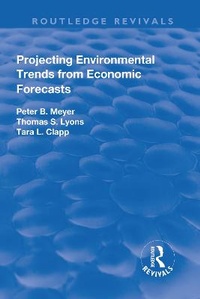
Projecting Environmental Trends from Economic Forecasts
1st Edition
Published on 16. January 2019
Book
Paperback/Softback
170 pages
978-1-138-72605-5 (ISBN)
Description
This title was first published in 2000: Sustainable development offers visions of the future, but implementation of new sustainable policies seems slow. This text presents a forecasting method directed to overcome some barriers to the implementation of more sustainable economic policy. Using a case study, the authors describe how economic and environmental forecasts can be developed that are relevant to the immediate concerns of policy-makers and are more likely to lead to policy changes. A combination of forecasting methods are shown to evaluate a range of current alternatives in the future. Similar techniques have been used in developing countries, but here the techniques are applied to an already industrialized economy.
More details
Series
Language
English
Place of publication
London
United Kingdom
Publishing group
Taylor & Francis Ltd
Target group
College/higher education
Professional and scholarly
Dimensions
Height: 216 mm
Width: 150 mm
Weight
310 gr
ISBN-13
978-1-138-72605-5 (9781138726055)
Copyright in bibliographic data and cover images is held by Nielsen Book Services Limited or by the publishers or by their respective licensors: all rights reserved.
Schweitzer Classification
Other editions
Additional editions
Peter Meyer | Thomas Lyons | Tara Clapp
Projecting Environmental Trends from Economic Forecasts
E-Book
11/2017
Routledge
€47.49
Available for download
Peter Meyer | Thomas Lyons | Tara Clapp
Projecting Environmental Trends from Economic Forecasts
E-Book
11/2017
Routledge
€47.49
Available for download
Peter Meyer | Thomas Lyons | Tara Clapp
Projecting Environmental Trends from Economic Forecasts
Book
10/2017
1st Edition
Routledge
€106.65
Shipment within 10-20 days
Persons
Meyer, Peter; Lyons, Thomas; Clapp, Tara
Content
List of figures and tables, Acknowledgments, 1. Forecasting for sustainability, 2. Process overview and rationale, 3. Scanning context and setting priorities, 4. Social research for forecasting: Nominal group techniques in scenario building, 5. Environmental impact modeling from scenario projections, 6. Comparing the effects of economic activity, technologies and practices on environmental impacts, 7. Forecasting for sustainability conclusions, findings and potential, Bibliography, Appendix One: Current trends in Kentucky, List of acronyms