

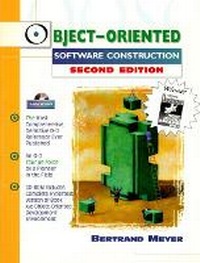
Object-Oriented Software Construction (Book/CD-ROM)
2nd Edition
Published on 27. May 1997
Book
Mixed media product
1296 pages
978-0-13-629155-8 (ISBN)
Description
For any software engineer, developer or programmer interested in O-O software and programming.
This long-awaited revision retains the clarity, practicality and innovations that helped the first edition sell over 75,000 copies since 1988. Now over 1200 pages with a CD ROM full of object tools, this edition is fully revised and considerably expanded, making it THE definitive reference on the most promising software development in 30 years.
This long-awaited revision retains the clarity, practicality and innovations that helped the first edition sell over 75,000 copies since 1988. Now over 1200 pages with a CD ROM full of object tools, this edition is fully revised and considerably expanded, making it THE definitive reference on the most promising software development in 30 years.
More details
Edition
2nd edition
Language
English
Place of publication
Upper Saddle River
United States
Publishing group
Pearson Education (US)
Target group
College/higher education
Dimensions
Height: 230 mm
Width: 180 mm
Thickness: 40 mm
Weight
1692 gr
ISBN-13
978-0-13-629155-8 (9780136291558)
Copyright in bibliographic data and cover images is held by Nielsen Book Services Limited or by the publishers or by their respective licensors: all rights reserved.
Schweitzer Classification
Other editions
Previous edition

Ockert Meyer
Object-Oriented Software Construction
Book
09/1997
2nd Edition
Prentice-Hall
€33.37
Article exhausted; check for reprint
Person
BERTRAND MEYER is one of the pioneers of modern software engineering, whose experience spans both industry and academia. He has led the development of successful O-O products and libraries totaling thousands of classes. His Prentice Hall books include Object Success (an introduction to object technology for managers), Introduction to the Theory of Programming Languages, Eiffel: The Language, Object-Oriented Applications, and Reusable Software. He is a frequent keynote speaker at international conferences and consultant for Fortune 500 companies, editor of the Object-Oriented Series, associate member of the applications section of the French Academy of Sciences, chairman of the TOOLS conference series, and editor of the Object Technology department of IEEE Computer.
Content
PART A: THE ISSUES.
1. Software Quality.
2. Criteria of Object Orientation.
PART B: THE ROAD TO OBJECT ORIENTATION.
3. Modularity.
4. Approaches to Reusability.
5. Towards Object Technology.
6. Abstract Data Types.
PART C: OBJECT-ORIENTED TECHNIQUES.
7. The Static Structure: Classes.
8. The Run-Time Structure: Objects.
9. Memory Management.
10. Genericity
11. Design By Contract: Building Reusable Software.
12. When the Contract is Broken: Exception Handling.
13. Supporting Mechanisms.
14. Introduction to Inheritance.
15. Multiple Inheritance.
16. Inheritance Techniques.
17. Typing.
18. Global Objects and Constraints.
PART D: OBJECT-ORIENTED METHODOLOGY: APPLYING THE METHOD WELL.
19. On Methodology.
20. Design Pattern: Multi-panel Interactive Systems.
21. Inheritance Case Study: "undo" in an Interactive System.
22. How to Find the Classes.
23. Principles of Class Design.
24. Using Inheritance Well.
25. Useful Techniques.
26. A Sense of Style.
27. Object-Oriented Analysis.
28. The Software Construction Process.
29. Teaching the Method.
PART E: ADVANCED TOPICS.
30. Concurrency, Distribution, Client-Server and the Internet.
31. Object Persistence and Databases.
32. Some O-O Techniques for Graphical Interactive Applications.
PART F: APPLYING THE METHOD IN VARIOUS LANGUAGES AND ENVIRONMENTS.
33. O-O Programming and Ada.
34. Emulating Object Technology in non-O-O Environments.
35. Simula to Java and Beyond: Major O-O Languages and Environments.
PART G: DOING IT RIGHT.
36. An Object-Oriented Environment.
Epilogue.
PART H: APPENDICES.
Appendix A: Extracts From the Base Libraries.
Appendix B: Genericity Versus Inheritance.
Appendix C: Principles, Rules, Precepts and Definitions.
Appendix D: A Glossary of Object Technology.
Appendix E: Bibliography Index.
Bibliography.
1. Software Quality.
2. Criteria of Object Orientation.
PART B: THE ROAD TO OBJECT ORIENTATION.
3. Modularity.
4. Approaches to Reusability.
5. Towards Object Technology.
6. Abstract Data Types.
PART C: OBJECT-ORIENTED TECHNIQUES.
7. The Static Structure: Classes.
8. The Run-Time Structure: Objects.
9. Memory Management.
10. Genericity
11. Design By Contract: Building Reusable Software.
12. When the Contract is Broken: Exception Handling.
13. Supporting Mechanisms.
14. Introduction to Inheritance.
15. Multiple Inheritance.
16. Inheritance Techniques.
17. Typing.
18. Global Objects and Constraints.
PART D: OBJECT-ORIENTED METHODOLOGY: APPLYING THE METHOD WELL.
19. On Methodology.
20. Design Pattern: Multi-panel Interactive Systems.
21. Inheritance Case Study: "undo" in an Interactive System.
22. How to Find the Classes.
23. Principles of Class Design.
24. Using Inheritance Well.
25. Useful Techniques.
26. A Sense of Style.
27. Object-Oriented Analysis.
28. The Software Construction Process.
29. Teaching the Method.
PART E: ADVANCED TOPICS.
30. Concurrency, Distribution, Client-Server and the Internet.
31. Object Persistence and Databases.
32. Some O-O Techniques for Graphical Interactive Applications.
PART F: APPLYING THE METHOD IN VARIOUS LANGUAGES AND ENVIRONMENTS.
33. O-O Programming and Ada.
34. Emulating Object Technology in non-O-O Environments.
35. Simula to Java and Beyond: Major O-O Languages and Environments.
PART G: DOING IT RIGHT.
36. An Object-Oriented Environment.
Epilogue.
PART H: APPENDICES.
Appendix A: Extracts From the Base Libraries.
Appendix B: Genericity Versus Inheritance.
Appendix C: Principles, Rules, Precepts and Definitions.
Appendix D: A Glossary of Object Technology.
Appendix E: Bibliography Index.
Bibliography.