

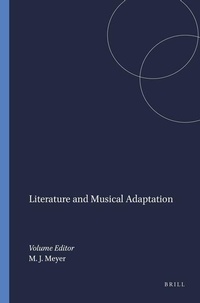
Literature and Musical Adaptation
Published on 1. January 2002
Book
Paperback/Softback
224 pages
978-90-420-0802-1 (ISBN)
Description
It can safely be said that when literary texts are utilized or adapted by a musician to create a new work of art, it is seldom that a diminished or lessened product results. Rather, such a merging usually enlarges and enhances both text and tune, perhaps significantly changing the message of the original. Discovering exactly what the new form has to offer and how it relates to the text or melody that preceded it is often a daunting task, requiring a close examination of both the author's and the composer's intent.
The essays in this collection offer an analysis of several adaptations, some successful, some not so successful, and attempt to assess just what the musicians or writers have modified or changed from to the original as they re-form it into an altogether different media. Ranging from Pasternak's appropriation of Tchaikovsky to Britten's operatic versions of Billy Budd and the Turn of the Screw, from Celan's use of fugal technique in his "Todesfuge" to the way that the musicianship of several women writers found voice in their writing, a broad spectrum of collaborations is examined. As readers examine an author's respect for a long dead musician (Hopkins' admiration of Purcell) or as they discover how John Harbison worked to transform Fitzgerald's musicality in The Great Gatsby, it will be evident that musical adaptations often provide a richness that the originals did not possess and that the potential for greatness is heightened when the arts intersect.
The essays in this collection offer an analysis of several adaptations, some successful, some not so successful, and attempt to assess just what the musicians or writers have modified or changed from to the original as they re-form it into an altogether different media. Ranging from Pasternak's appropriation of Tchaikovsky to Britten's operatic versions of Billy Budd and the Turn of the Screw, from Celan's use of fugal technique in his "Todesfuge" to the way that the musicianship of several women writers found voice in their writing, a broad spectrum of collaborations is examined. As readers examine an author's respect for a long dead musician (Hopkins' admiration of Purcell) or as they discover how John Harbison worked to transform Fitzgerald's musicality in The Great Gatsby, it will be evident that musical adaptations often provide a richness that the originals did not possess and that the potential for greatness is heightened when the arts intersect.
More details
Series
Language
English
German
Place of publication
Leiden
Netherlands
Publishing group
Brill
Target group
College/higher education
Professional and scholarly
Product notice
Paperback (trade)
Unsewn / adhesive bound
Dimensions
Height: 235 mm
Width: 155 mm
Weight
386 gr
ISBN-13
978-90-420-0802-1 (9789042008021)
Copyright in bibliographic data and cover images is held by Nielsen Book Services Limited or by the publishers or by their respective licensors: all rights reserved.
Schweitzer Classification
Other editions
Additional editions
Michael J. Meyer
Literature and Musical Adaptation
Book
01/2002
Rodopi
€68.22
Article exhausted; check different version
Person
Michael J. Meyer is Adjunct Professor of English at DePaul and Northeastern Illinois Universities in Chicago. He is the new Steinbeck bibliographer, and his essays on Steinbeck have appeared in numerous books and journals. His most recent Steinbeck scholarship is Cain Sign: The Betrayal of Brotherhood in the Work of John Steinbeck (Mellen 2000). Meyer has also edited three other books for Rodopi Press's series entitled Perspectives in Modern Literature including Literature and Ethnic Discrimination, Literature and Homosexuality and Literature and the Grotesque. He is presently working as co-editor of the new Steinbeck Encyclopaedia (Greenwood, forthcoming).
Content
1. Irene Morra: " 'A Song Not Without Words': Singing Billy Budd"
2. Kim Moreland: Music in The Great Gatsby and The Great Gatsby as Music
3. Jennifer Stolpa: Henry Purcell and Gerard Manley Hopkins: Two Explorations of Identity
4. Gyllian Phillips: "Something Lies Beyond the Scene [seen]" of Facade: Sitwell, Walton and Kristeva's Semiotic
5. Jenifer Cushman: "Dann sang er": Das Marienleben from Rilke to Hindemith
6. Karen Evans-Romaine: Pasternak and Tchaikovsky: Musical Echoes in Pasternak's Blind Beauty
7. David Clippinger: The Hidden Life: Benjamin Britten's Homoerotic Reading of Henry James's The Turn of the Screw
8. Karl Henzy: Musical Interpretations of Modernist Literature
9. Sarah Ann Wider: When Performance Ends: Musicians as Writers
10. Solveig Olsen: Celan's "Todesfuge": The Musical Dimension of a Verbal Composition
2. Kim Moreland: Music in The Great Gatsby and The Great Gatsby as Music
3. Jennifer Stolpa: Henry Purcell and Gerard Manley Hopkins: Two Explorations of Identity
4. Gyllian Phillips: "Something Lies Beyond the Scene [seen]" of Facade: Sitwell, Walton and Kristeva's Semiotic
5. Jenifer Cushman: "Dann sang er": Das Marienleben from Rilke to Hindemith
6. Karen Evans-Romaine: Pasternak and Tchaikovsky: Musical Echoes in Pasternak's Blind Beauty
7. David Clippinger: The Hidden Life: Benjamin Britten's Homoerotic Reading of Henry James's The Turn of the Screw
8. Karl Henzy: Musical Interpretations of Modernist Literature
9. Sarah Ann Wider: When Performance Ends: Musicians as Writers
10. Solveig Olsen: Celan's "Todesfuge": The Musical Dimension of a Verbal Composition