

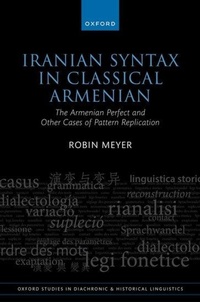
Iranian Syntax in Classical Armenian
The Armenian Perfect and Other Cases of Pattern Replication
Published on 7. December 2023
Book
Hardback
336 pages
978-0-19-885109-7 (ISBN)
Description
This is an open access title available under the terms of a CC BY-NC-ND 4.0 International licence. It is free to read at Oxford Academic and offered as a free PDF download from OUP and selected open access locations.
This book draws on a detailed corpus analysis of fifth-century historiographical texts to explore the influence of the Iranian languages on the syntax of Armenian. While contact between the Iranian languages - particularly Parthian - and Armenian has been a fertile field of research for several decades, its effects on syntax have to date been somewhat neglected. Here, Robin Meyer argues that the Armenian periphrastic perfect construction with its unusual morphosyntactic alignment was created on the model of similar constructions in Parthian, along with a number of other syntagms. Unlike previous accounts, the language contact model presented in this book can explain all the idiosyncrasies of the construction, as well as its diachronic developments. The study also offers new insights into the historical social dynamics between Armenian and Parthian speakers, and suggests that the Parthians, who were the ruling class in the Armenian Kingdom for almost four centuries, eventually abandoned their native language.
This book draws on a detailed corpus analysis of fifth-century historiographical texts to explore the influence of the Iranian languages on the syntax of Armenian. While contact between the Iranian languages - particularly Parthian - and Armenian has been a fertile field of research for several decades, its effects on syntax have to date been somewhat neglected. Here, Robin Meyer argues that the Armenian periphrastic perfect construction with its unusual morphosyntactic alignment was created on the model of similar constructions in Parthian, along with a number of other syntagms. Unlike previous accounts, the language contact model presented in this book can explain all the idiosyncrasies of the construction, as well as its diachronic developments. The study also offers new insights into the historical social dynamics between Armenian and Parthian speakers, and suggests that the Parthians, who were the ruling class in the Armenian Kingdom for almost four centuries, eventually abandoned their native language.
Reviews / Votes
The reviewed monograph successfully combines skillful work with linguistic and sociohistorical data, manages to achieve the goals set by the author, and offers a valuable insight into what the facts of language can tell us about history, and the facts of history can tell us about language. * Danil Alekseev, Department of Theoretical and Applied Linguistics at Lomonosov Moscow State University *More details
Series
Language
English
Place of publication
Oxford
United Kingdom
Target group
College/higher education
Product notice
sewn/stitched
Cloth over boards
Dimensions
Height: 231 mm
Width: 163 mm
Thickness: 43 mm
Weight
658 gr
ISBN-13
978-0-19-885109-7 (9780198851097)
Copyright in bibliographic data and cover images is held by Nielsen Book Services Limited or by the publishers or by their respective licensors: all rights reserved.
Schweitzer Classification
Other editions
Additional editions
Robin Meyer
Iranian Syntax in Classical Armenian
The Armenian Perfect and Other Cases of Pattern Replication
E-Book
12/2023
1st Edition
OUP eBook
€98.99
Available for download
Person
Robin Meyer has been Assistant Professor in Historical Linguistics at the University of Lausanne since 2020. He completed his doctorate on language contact between West Middle Iranian and Classical Armenian at Oxford in 2017, following which he held the positions of Diebold Research Associate in Comparative Philology and Junior Research Fellow at Wolfson College. Since 2019 he has also been a member of the Council of the Philological Society.
Content
1: Introduction
2: Linguistic evidence for Iranian influence on Armenian
3: Socio-historical evidence for Iranian influence on Armenian
4: Morphosyntactic alignment
5: The syntax of the Armenian perfect: A corpus analysis
6: Other cases of Iranian-Armenian pattern replication
7: Parthian-Armenian language contact and its historical context
8: Conclusions
Appendix: Historical morphology of the Armenian -eal participle
2: Linguistic evidence for Iranian influence on Armenian
3: Socio-historical evidence for Iranian influence on Armenian
4: Morphosyntactic alignment
5: The syntax of the Armenian perfect: A corpus analysis
6: Other cases of Iranian-Armenian pattern replication
7: Parthian-Armenian language contact and its historical context
8: Conclusions
Appendix: Historical morphology of the Armenian -eal participle