

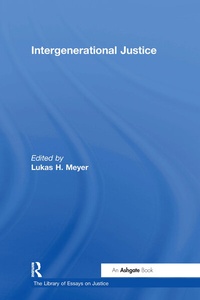
Intergenerational Justice
1st Edition
Published on 9. May 2012
Book
Hardback
522 pages
978-0-7546-2985-6 (ISBN)
Description
The essays selected for this volume show how relations between past, current and future generations have become a major subject of philosophical research since the 1970s. The relations between people alive today with people who may exist in the future and people now deceased, differ from relations between contemporaries and in ways that raise new conceptual, logical and substantive questions. Among the questions addressed in this volume are: what is the status of people now deceased and people who may exist in the future? Can the latter be harmed by the actions of people alive today? What duties of justice do we have towards people with whom we can neither interact nor co-operate, and can people who are indirect victims of past injustices legitimately claim compensation? Answers to these questions are relevant in a number of policy areas, most notably in issues regarding reparations for historical injustice and responding to climate change and its consequences.
More details
Series
Language
English
Place of publication
London
United Kingdom
Publishing group
Taylor & Francis Ltd
Target group
College/higher education
Dimensions
Height: 246 mm
Width: 174 mm
Weight
1238 gr
ISBN-13
978-0-7546-2985-6 (9780754629856)
Copyright in bibliographic data and cover images is held by Nielsen Book Services Limited or by the publishers or by their respective licensors: all rights reserved.
Schweitzer Classification
Other editions
Additional editions
Lukas H. Meyer
Intergenerational Justice
E-Book
05/2017
1st Edition
Routledge
€60.49
Available for download
Lukas H. Meyer
Intergenerational Justice
E-Book
05/2017
1st Edition
Routledge
€60.49
Available for download
Person
Lukas H. Meyer is Professor of Philosophy and Head of the Department of Philosophy, University of Graz, Austria
Content
Contents: Introduction; Part I Foundations: Utilitarianism and new generations, Jan Narveson; Distributive shares, John Rawls; The non-identity problem, Derek Parfit; The intractability of the non-identity problem, David Heyd; Surviving duties and symbolic compensation, Lukas H. Meyer; Discounting the future, John Broome; What motivates us to care for the (distant) future?, Dieter Birnbacher. Part II Substantive Principles of Intergenerational Justice: Wrongful life, procreative responsibility, and the significance of harm, Seana Valentine Shiffrin; Sustainability and intergenerational justice, Brian Barry; Nonideal theory, John Rawls; Enough for the future, Lukas H. Meyer and Dominic Roser; Three models of intergenerational reciprocity, Axel Gosseries; Life extension versus replacement, Gustaf Arrhenius; The pure intergenerational problem, Stephen M. Gardiner; Climate change and the duties of the advantaged, Simon Caney. Part III Normative Significance of Historical Injustices and their Consequences: The new Indian claims and original rights to land, David Lyons; Superseding historic injustice, Jeremy Waldron; The apology paradox, Janna Thompson; Transgenerational compensation, George Sher; Who can be wronged?, Rahul Kumar; On benefiting from injustice, Daniel Butt; Climate justice and historical emissions, Lukas H. Meyer and Dominic Roser; Name index.