

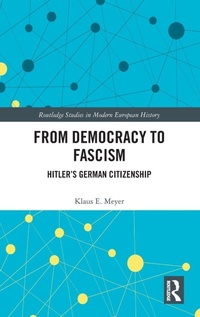
From Democracy to Fascism
Hitler's German Citizenship
1st Edition
Will be published approx. on 2. July 2026
Book
Hardback
256 pages
978-1-041-12527-3 (ISBN)
Description
How did a democratic society turn fascist? This book explores the political dynamics of the Free State of Braunschweig from 1930 to 1933 surrounding Adolf Hitler's appointment to civil service - a decision enabled by the traditional conservative parties that paved his path to German citizenship.
Upheavals and structural changes in the economy and society during the turbulent decade after the 1918 revolution had shaped voters' worldviews and personal experiences. Many became increasingly frustrated with the parties operating within the rules of the still-novel democracy and voted for parties that rejected the republic. Bourgeois politicians formed a coalition with the National Socialists in 1930 and then progressively acceded to their demands. Civil society leaders were embroiled in conflicts with the National Socialist Minister of the Interior, or caved in. By reinvestigating the processes through which fascists built community support, this book deep-dives beyond more superficial discourse on the roots of political extremism and provides a historical perspective to inform contemporary debates.
This volume is intended both for general readers interested in the processes of democracy turning into autocracy and for historians seeking to fill critical gaps in our understanding of the Weimar Republic and in the biography of Adolf Hitler.
Upheavals and structural changes in the economy and society during the turbulent decade after the 1918 revolution had shaped voters' worldviews and personal experiences. Many became increasingly frustrated with the parties operating within the rules of the still-novel democracy and voted for parties that rejected the republic. Bourgeois politicians formed a coalition with the National Socialists in 1930 and then progressively acceded to their demands. Civil society leaders were embroiled in conflicts with the National Socialist Minister of the Interior, or caved in. By reinvestigating the processes through which fascists built community support, this book deep-dives beyond more superficial discourse on the roots of political extremism and provides a historical perspective to inform contemporary debates.
This volume is intended both for general readers interested in the processes of democracy turning into autocracy and for historians seeking to fill critical gaps in our understanding of the Weimar Republic and in the biography of Adolf Hitler.
More details
Series
Language
English
Place of publication
London
United Kingdom
Publishing group
Taylor & Francis Ltd
Target group
Professional and scholarly
Academic
Illustrations
16 s/w Tabellen
16 Tables, black and white
Dimensions
Height: 234 mm
Width: 156 mm
Weight
670 gr
ISBN-13
978-1-041-12527-3 (9781041125273)
Copyright in bibliographic data and cover images is held by Nielsen Book Services Limited or by the publishers or by their respective licensors: all rights reserved.
Schweitzer Classification
Other editions
Additional editions
E-Book
approx. 07/2026
Routledge
€60.99
Available for download
E-Book
approx. 07/2026
Routledge
€60.99
Available for download
Person
Klaus E. Meyer, PhD, is a professor of international business at Ivey Business School in London, Ontario, Canada. His scholarship focuses on strategies of multinational companies in emerging economies, highlighting the importance of context for management. Dr. Meyer's historical work examines the local societal conditions that led to support for the National Socialists in the late Weimar Republic.
Content
1. A Historical City 2. Revolution 3. Not So Golden Twenties 4. Republic 5. 1930: Watershed Elections 6. 1930: Coalition Government 7. 1931: Minister Dietrich Klagges 8. 1931/32: Entrenchment in Civil Society 9. 1932: The Citizenship 10. 1932: The March to Power 11. 1933: The "First" 100 Days 12. Epilogue: Lessons Learned?