

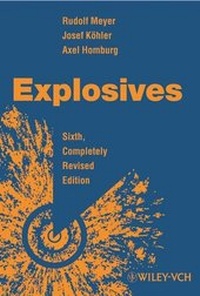
Explosives
6th Edition
Published on 25. July 2007
Book
VIII, 422 pages
978-3-527-31656-4 (ISBN)
Description
This world-famous work has been enlarged and updated without tampering with its tried and tested format. Around 500 alphabetically ordered, monographic entries consider the physicochemical properties, production methods and safe applications of over 120 explosive chemicals, while discussing 70 fuels, additives and oxidizing agents and describing the relevant test methods.
The extensive thermodynamic data has been thoroughly updated and now also provided on a CD-ROM compiled by the Fraunhofer Institute of Chemical Technology. This excerpt from the ICT Thermodynamical Database not only includes additional thermodynamic data, and references to further reading, but also features enhanced search facilities.
Other key features include a 1,500-entry combined index and glossary with terms and abbreviations in English, French and German, conversion tables and numerous literature references.
A handy reference for explosive experts and also for translators, public authorities and patent lawyers.
From reviews of previous editions:
'... This wealth of information and an index that comprises some 1500 keywords and several conversion tables make this a unique source of knowledge for anybody working with explosives.' (Propellants, Explosives, Pyrotechnics)
Die sechste Auflage dieses Nachschlagewerkes ist erneut erweitert und aktualisiert worden; das in der fünften Auflage bewährte Konzept mit CD-ROM wurde beibehalten.
Der Textteil beschreibt ausführlich mehr als 500 Begriffe in alphabetischer Reihenfolge, darunter über 120 mit Strukturformel und Daten versehene chemische Verbindungen mit Explosivcharakter.
Zu fast jeder Verbindung werden die wichtigsten chemisch-physikalischen und sicherheitstechnischen Kenndaten aufgeführt; die Gefahrgutregularien wurden gründlich überarbeitet. Der Leser findet außerdem Angaben zu den Herstellungsverfahren und Verwendungsmöglichkeiten dieser Stoffe sowie zu etwa 70 Additiven, Brennstoffen und Oxidantien.
Das Fraunhofer Institut für Chemische Technologie in Pfinztal hat aus der ICT-Thermodynamik-Datenbank, die für das Buch relevanten Verbindungen ausgesucht und sie auf einer CD-ROM zur Verfügung gestellt. Diese bietet über das Buch hinaus zusätzliche thermodynamische Daten, Hinweise zu weiterführender Literatur und vor allem eine zeitgemäße Suchmöglichkeit.
Etwa 1500 Einträge im Schlagwortregister, die Angabe der englischen und französischen Übersetzungen und die Erklärung von Kurzbezeichnungen machen dieses Buch zu einem umfassenden und aktuellen Lexikon.
Es eignet sich sowohl für Explosivstoff-Experten, als auch für Übersetzer, Behörden und Patentanwälte.
The extensive thermodynamic data has been thoroughly updated and now also provided on a CD-ROM compiled by the Fraunhofer Institute of Chemical Technology. This excerpt from the ICT Thermodynamical Database not only includes additional thermodynamic data, and references to further reading, but also features enhanced search facilities.
Other key features include a 1,500-entry combined index and glossary with terms and abbreviations in English, French and German, conversion tables and numerous literature references.
A handy reference for explosive experts and also for translators, public authorities and patent lawyers.
From reviews of previous editions:
'... This wealth of information and an index that comprises some 1500 keywords and several conversion tables make this a unique source of knowledge for anybody working with explosives.' (Propellants, Explosives, Pyrotechnics)
Die sechste Auflage dieses Nachschlagewerkes ist erneut erweitert und aktualisiert worden; das in der fünften Auflage bewährte Konzept mit CD-ROM wurde beibehalten.
Der Textteil beschreibt ausführlich mehr als 500 Begriffe in alphabetischer Reihenfolge, darunter über 120 mit Strukturformel und Daten versehene chemische Verbindungen mit Explosivcharakter.
Zu fast jeder Verbindung werden die wichtigsten chemisch-physikalischen und sicherheitstechnischen Kenndaten aufgeführt; die Gefahrgutregularien wurden gründlich überarbeitet. Der Leser findet außerdem Angaben zu den Herstellungsverfahren und Verwendungsmöglichkeiten dieser Stoffe sowie zu etwa 70 Additiven, Brennstoffen und Oxidantien.
Das Fraunhofer Institut für Chemische Technologie in Pfinztal hat aus der ICT-Thermodynamik-Datenbank, die für das Buch relevanten Verbindungen ausgesucht und sie auf einer CD-ROM zur Verfügung gestellt. Diese bietet über das Buch hinaus zusätzliche thermodynamische Daten, Hinweise zu weiterführender Literatur und vor allem eine zeitgemäße Suchmöglichkeit.
Etwa 1500 Einträge im Schlagwortregister, die Angabe der englischen und französischen Übersetzungen und die Erklärung von Kurzbezeichnungen machen dieses Buch zu einem umfassenden und aktuellen Lexikon.
Es eignet sich sowohl für Explosivstoff-Experten, als auch für Übersetzer, Behörden und Patentanwälte.
Reviews / Votes
'... This book may, perhaps, be considered as an encyclopedia of explosives. It lists virtually all known explosives. Some are described in considerable detail, while others are simply listed. Many formulation and composition generalities are given. However, it is not a recipe book for someone wanting to make an explosive ... . The book should be a valuable addition to any technical library.' (Industrial Chemist) '... The audience for this book would be anyone needing fundamental information on individual explosives. The descriptions and the illustrations are quite clear and in many cases were checked for accuracy by the manufacturer.' (ARBA) '... This wealth of information and an index that comprises some 1500 keywords and several conversion tables make this a unique source of knowledge for anybody working with explosives.' (Propellants, Explosives, Pyrotechnics) '... The objective of the book is to provide fundamental information on explosives to both the experts and the general public, making it of use to anybody working with explosives in the civil and military fields' (Mining Engineering)More details
Edition
6. vollständig überarbeitete Auflage
Language
English
Place of publication
Weinheim
Germany
Target group
Professional and scholarly
Edition type
Revised edition
Product notice
Plastic-covered
Illustrations
20
20 s/w Abbildungen
Illustrations
Dimensions
Height: 21 cm
Width: 14.8 cm
Thickness: 2.4 cm
Weight
975 gr
ISBN-13
978-3-527-31656-4 (9783527316564)
Schweitzer Classification
Other editions
New editions
Rudolf Meyer | Josef Köhler | Axel Homburg
Explosives
Book
04/2016
7th Edition
Wiley-VCH
€192.00
Shipment within 5-7 days
Additional editions
Rudolf Meyer | Josef Köhler | Axel Homburg
Explosives
E-Book
01/2008
6th Edition
Wiley-VCH
€250.99
Available for download
Previous edition

Rudolf Meyer | Josef Köhler | Axel Homburg
Explosives
Book
02/2002
5th Edition
Wiley-VCH
€179.00
Article exhausted; check for reprint
Persons
Born in Braunschweig in 1962, Josef Köhler trained as a pyrotechnician and an authorized user of explosives, completing his degree in chemical engineering in 1988. After completing his basic military service, he began his professional career as an administrator in the R&D department of an explosives company. From 1991 onwards, he worked initially as the assistant to the works manager in producing combustible ammunition, and was promoted to manager two years later. In 1996 he left to found his own company in Austria, where he mainly works on the development and production of pyrotechnical special effects for the British film industry. Additionally, he creates new, environmentally friendly priming explosives and works in the field of detonation and ignition technology. As well as being a technical writer, Josef Köhler works as a freelance lecturer and sworn expert for the courts.
Axel Homburg was born in 1936 in Hanover, and studied at the Technische Hochschule in Darmstadt, where he gained his doctorate in the field of jet engines and rocket technology. From 1963 to 1968 he was a scientific assistant at the TH Darmstadt, before joining the "Propellants" department at Dynamit Nobel AG in 1969. In 1972 he became head of the main R&D department for explosives, the business unit he represented when he joined the board in 1983. From 1987 through 1997 Dr. Homburg was chairman of the board at Dynamit Nobel AG, switching to the supervisory board upon his retirement in 1998, where he remained a member until 2002. He sits on various national and international committees, and has been chairman of the board of trustees at the Fraunhofer Institute for chemical Technology (ICT) since 1994 and a member of the board of trustees at the Federal Institute for Materials Research and Testing (BAM) since 1989.
Axel Homburg was born in 1936 in Hanover, and studied at the Technische Hochschule in Darmstadt, where he gained his doctorate in the field of jet engines and rocket technology. From 1963 to 1968 he was a scientific assistant at the TH Darmstadt, before joining the "Propellants" department at Dynamit Nobel AG in 1969. In 1972 he became head of the main R&D department for explosives, the business unit he represented when he joined the board in 1983. From 1987 through 1997 Dr. Homburg was chairman of the board at Dynamit Nobel AG, switching to the supervisory board upon his retirement in 1998, where he remained a member until 2002. He sits on various national and international committees, and has been chairman of the board of trustees at the Fraunhofer Institute for chemical Technology (ICT) since 1994 and a member of the board of trustees at the Federal Institute for Materials Research and Testing (BAM) since 1989.
Content
Über 500 Begriffe in alphabetischer Reihenfolge, darunter über 120 mit Strukturformel und Daten versehene chemische Verbindungen mit Explosivcharakter.