

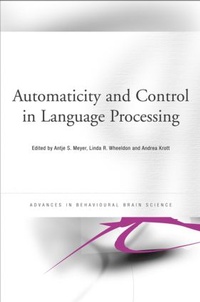
Automaticity and Control in Language Processing
1st Edition
Published on 14. December 2006
Book
Hardback
306 pages
978-1-84169-650-8 (ISBN)
Description
The use of language is a fundamental component of much of our day-to-day life. Language often co-occurs with other activities with which it must be coordinated. This raises the question of whether the cognitive processes involved in planning spoken utterances and in understanding them are autonomous or whether they are affected by, and perhaps affect, non-linguistic cognitive processes, with which they might share processing resources. This question is the central concern of Automaticity and Control in Language Processing.
The chapters address key issues concerning the relationship between linguistic and non-linguistic processes, including:
How can the degree of automaticity of a component be defined?
Which linguistic processes are truly automatic, and which require processing capacity?
Through which mechanisms can control processes affect linguistic performance? How might these mechanisms be represented in the brain?
How do limitations in working memory and executive control capacity affect linguistic performance and language re-learning in persons with brain damage?
This important collection from leading international researchers will be of great interest to researchers and students in the area.
The chapters address key issues concerning the relationship between linguistic and non-linguistic processes, including:
How can the degree of automaticity of a component be defined?
Which linguistic processes are truly automatic, and which require processing capacity?
Through which mechanisms can control processes affect linguistic performance? How might these mechanisms be represented in the brain?
How do limitations in working memory and executive control capacity affect linguistic performance and language re-learning in persons with brain damage?
This important collection from leading international researchers will be of great interest to researchers and students in the area.
More details
Series
Language
English
Place of publication
Hove
United Kingdom
Publishing group
Taylor & Francis Ltd
Target group
College/higher education
Illustrations
4 Farbfotos bzw. farbige Rasterbilder, 47 s/w Zeichnungen, 8 s/w Tabellen
8 Tables, black and white; 47 Line drawings, black and white; 4 Halftones, color
Dimensions
Height: 234 mm
Width: 156 mm
Weight
730 gr
ISBN-13
978-1-84169-650-8 (9781841696508)
Copyright in bibliographic data and cover images is held by Nielsen Book Services Limited or by the publishers or by their respective licensors: all rights reserved.
Schweitzer Classification
Other editions
Additional editions
Antje Meyer | Linda Wheeldon | Andrea Krott
Automaticity and Control in Language Processing
Book
08/2015
1st Edition
Psychology Press Ltd
€47.50
Shipment within 15-20 days
Antje Meyer | Linda Wheeldon | Andrea Krott
Automaticity and Control in Language Processing
E-Book
01/2007
Psychology Press Ltd
€47.49
Available for download
Antje Meyer | Linda Wheeldon | Andrea Krott
Automaticity and Control in Language Processing
E-Book
01/2007
1st Edition
Psychology Press Ltd
€47.49
Available for download
Persons
Antje S. Meyer is Professor of Psycholinguistics at the School of Psychology at the University of Birmingham, UK.
Linda Wheeldon is Senior Lecturer in the School of Psychology at the University of Birmingham, UK.
Andrea Krott is Lecturer in the School of Psychology at the University of Birmingham, UK.
Linda Wheeldon is Senior Lecturer in the School of Psychology at the University of Birmingham, UK.
Andrea Krott is Lecturer in the School of Psychology at the University of Birmingham, UK.
Content
Preface. S. Garrod, M.J. Pickering Automaticity of language production in monologue and dialogue. K. Bock, G.S. Dell, S.M. Garnsey, A.F. Kramer, T.T. Kubose Car talk, car listen. J. Rayner, A.W. Ellis The control of bilingual language switching. V.S. Ferreira How are speakers' linguistic choices affected by ambiguity? R.J. Hartsuiker Studies on verbal self-monitoring: The perceptual loop model and beyond. A. Roelofs, M. Lamers Modelling the control of visual attention in Stroop-like tasks. G.W. Humphreys, E.M.E. Forde, E. Steer, D. Samson, C. Connelly. Executive functions in name retrieval: evidence from neuropsychology. R.C. Martin. Semantic short-term memory, language processing, and inhibition. M.A. Lambon Ralph, J.K. Fillingham. The importance of cognitive impairments in aphasia: evidence from the treatment of anomia using errorless and errorful learning. F. Pulvermueller, Y. Shtyrov Language outside the focus of attention: The Mismatch Negativity as an objective tool for studying higher language functions. P. Hagoort The memory, unification, and control (MUC) model of language.