

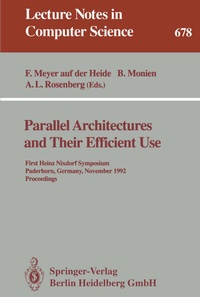
Parallel Architectures and Their Efficient Use
First Heinz Nixdorf Symposium, Paderborn, Germany, November 11-13, 1992. Proceedings
Published on 29. June 1993
Book
Paperback/Softback
XII, 236 pages
978-3-540-56731-8 (ISBN)
Description
Research in the field of parallel computer architectures and
parallel algorithms has been very successful in recent
years, and further progress isto be expected. On the other
hand, the question of basic principles of the architecture
of universal parallel computers and their realizations is
still wide open. The answer to this question must be
regarded as mostimportant for the further development of
parallel computing and especially for user acceptance.
The First Heinz Nixdorf Symposium brought together leading
experts in the field of parallel computing and its
applications to discuss the state of the art, promising
directions of research, and future perspectives. It was the
first in a series of Heinz Nixdorf Symposia,intended to
cover varying subjects from the research spectrum of the
Heinz Nixdorf Institute of the University of Paderborn.
This volume presents the proceedings of the symposium, which
was held in Paderborn in November1992. The contributions
are grouped into four parts: parallel computation models and
simulations, existing parallel machines, communication and
programming paradigms, and parallel algorithms.
More details
Series
Edition
1993 ed.
Language
English
Place of publication
Berlin
Germany
Publishing group
Springer Berlin
Target group
Professional and scholarly
Research
Illustrations
XII, 236 p.
Dimensions
Height: 235 mm
Width: 155 mm
Thickness: 14 mm
Weight
382 gr
ISBN-13
978-3-540-56731-8 (9783540567318)
DOI
10.1007/3-540-56731-3
Schweitzer Classification
Content
A combining mechanism for parallel computers.- A case for the PRAM as a standard programmer's model.- Hashing strategies for simulating shared memory on distributed memory machines.- Better parallel architectures via emulations.- Relations between models of parallel abstract machines.- Frontiers of parallel computing.- Cost effectiveness of data flow machines and vector processors.- The networks of the connection machine CM-5.- Massively parallel computing: Data distribution and communication.- A realizable efficient parallel architecture.- Hardware support for collective communication operations.- Programmable active memories: a performance assessment.- The role of randomness in the design of interconnection networks.- Chaos router: Finally, a practical adaptive router?.- An experimental study of wormhole routing in parallel computers.- Three non conventional paradigms of parallel computation.- Scalable parallel computers and scalable parallel codes: From theory to practice.- A framework for analyzing locality and portability issues in parallel computing.- Optimal implementation of general divide- and-conquer on the hypercube and related networks.- Parallel implementations of graph embeddings.- On sorting by prefix reversals and the diameter of pancake networks.