

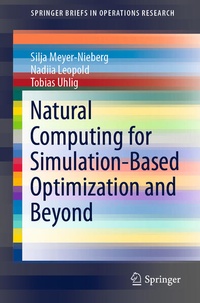
Natural Computing for Simulation-Based Optimization and Beyond
Published on 7. August 2019
Book
Paperback/Softback
VII, 60 pages
978-3-030-26214-3 (ISBN)
Description
This SpringerBrief bridges the gap between the areas of simulation studies on the one hand, and optimization with natural computing on the other. Since natural computing methods have been applied with great success in several application areas, a review concerning potential benefits and pitfalls for simulation studies is merited. The brief presents such an overview and combines it with an introduction to natural computing and selected major approaches, as well as with a concise treatment of general simulation-based optimization. As such, it is the first review which covers both the methodological background and recent application cases.
The brief is intended to serve two purposes: First, it can be used to gain more information concerning natural computing, its major dialects, and their usage for simulation studies. It also covers the areas of multi-objective optimization and neuroevolution. While the latter is only seldom mentioned in connection withsimulation studies, it is a powerful potential technique. Second, the reader is provided with an overview of several areas of simulation-based optimization which range from logistic problems to engineering tasks. Additionally, the brief focuses on the usage of surrogate and meta-models. The brief presents recent application examples.
The brief is intended to serve two purposes: First, it can be used to gain more information concerning natural computing, its major dialects, and their usage for simulation studies. It also covers the areas of multi-objective optimization and neuroevolution. While the latter is only seldom mentioned in connection withsimulation studies, it is a powerful potential technique. Second, the reader is provided with an overview of several areas of simulation-based optimization which range from logistic problems to engineering tasks. Additionally, the brief focuses on the usage of surrogate and meta-models. The brief presents recent application examples.
More details
Series
Edition
2020 ed.
Language
English
Place of publication
Cham
Switzerland
Publishing group
Springer International Publishing
Target group
Professional and scholarly
Illustrations
7 s/w Abbildungen, 2 farbige Abbildungen
VII, 60 p. 9 illus., 2 illus. in color.
Dimensions
Height: 235 mm
Width: 155 mm
Thickness: 5 mm
Weight
119 gr
ISBN-13
978-3-030-26214-3 (9783030262143)
DOI
10.1007/978-3-030-26215-0
Schweitzer Classification
Other editions
Additional editions
Silja Meyer-Nieberg | Nadiia Leopold | Tobias Uhlig
Natural Computing for Simulation-Based Optimization and Beyond
E-Book
07/2019
1st Edition
Springer
€52.99
Available for download
Persons
Silja Meyer-Nieberg
is a postdoctoral researcher at the ITIS GmbH. She holds a Ph.D. degree in Computer Science from the Technical University of Dortmund and obtained her venia legendi in Computer Science at the Bundeswehr University Munich. Her research interests include modeling, simulation-based optimization, metaheuristics, and computational intelligence. She is a member of the IEEE and GI societies and serves currently in the Editorial Board of Applied Soft Computing.
Nadiia Leopold is a doctoral student at the Department of Computer Science of the Universität der Bundeswehr München, Germany and a researcher at the ITIS GmbH. She received her degree in computer science from the National Aviation University, Kyiv Ukraine. Her research interests include modeling and simulation, optimization, and data analysis.
Tobias Uhlig is a postdoctoral researcher at the Universitat der Bundeswehr Munchen, Germany. He holds an M.Sc. degree in Computer Science from Dresden University of Technology and a Ph.D. degree in Computer Science from the Universitat der Bundeswehr Munchen. His research interests include operational modeling, natural computing and heuristic optimization. He is a member of the ASIM and the IEEE RAS Technical Committee on Semiconductor Manufacturing Automation. He is one of the founding members of the ASIM SPL work group BeESPL. He is the author of Self-Replicating Individuals .
Nadiia Leopold is a doctoral student at the Department of Computer Science of the Universität der Bundeswehr München, Germany and a researcher at the ITIS GmbH. She received her degree in computer science from the National Aviation University, Kyiv Ukraine. Her research interests include modeling and simulation, optimization, and data analysis.
Tobias Uhlig is a postdoctoral researcher at the Universitat der Bundeswehr Munchen, Germany. He holds an M.Sc. degree in Computer Science from Dresden University of Technology and a Ph.D. degree in Computer Science from the Universitat der Bundeswehr Munchen. His research interests include operational modeling, natural computing and heuristic optimization. He is a member of the ASIM and the IEEE RAS Technical Committee on Semiconductor Manufacturing Automation. He is one of the founding members of the ASIM SPL work group BeESPL. He is the author of Self-Replicating Individuals .
Content
Chapter 1. Introduction to Simulation-Based Optimization.- Chapter 2. Natural Computing and Optimization.- Chapter 3. Simulation-based Optimization.- Chapter 4 Conclusions.