

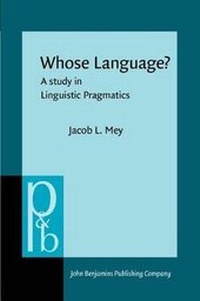
Whose Language?
A study in Linguistic Pragmatics
Published on 1. January 1985
Book
Paperback/Softback
412 pages
978-0-915027-57-6 (ISBN)
Description
"For the colonized person, objectivity is always directed against him" (Frantz Fanon). Colonized persons do not live on what we call (or used to call) the "colonies" alone. In general, objective reality, or the "facts of life", are very different depending on the kind of life you can afford. This goes for language as well; and it explains both the title of this book, and gives it its "raison d'etre". It deals with power in language, and asks: Who is really in command when we use "our" language? And why does it make sense to talk about a language of power (or lack of it)? The powerful are the colonizers, the colonized are the powerless, in language as in geopolitics. Colonizers and colonized alike, however, are subject to the social and economic conditions prevailing in society and therefore, a thorough analysis of these conditions is a must for any socially-oriented theory of language use.
More details
Series
Language
English
Place of publication
Amsterdam/Philadelphia
United States
Target group
Professional and scholarly
Dimensions
Height: 240 mm
Width: 160 mm
Weight
560 gr
ISBN-13
978-0-915027-57-6 (9780915027576)
Copyright in bibliographic data and cover images is held by Nielsen Book Services Limited or by the publishers or by their respective licensors: all rights reserved.
Schweitzer Classification
Person
Content
1. 0. About this book; 2. 0.0. Preliminary Remarks; 3. 0.1. Introduction; 4. 1. Language and manipulation; 5. 1.0. The cement of society; 6. 1.1. Manipulatory language: general; 7. 1.2. Manipulatory language: special; 8. 1.3. Concluding remarks; 9. 2. Language and industry; 10. 2.0. Introduction: Data selection; 11. 2.1. DR and the Oil Strike; 12. 2.2. Immigrant language education; 13. 3. Making a theory; 14. 3.0. Introduction; 15. 3.1. Wording; 16. 3.2. Language's rationale; 17. 3.3. Wording and society; 18. 3.4. Words and commodities; 19. 3.5. Industrial wording; 20. 3.6. A double logic; 21. 4. What about linguistics?; 22. 4.0. Introduction: Science and method; 23. 4.1. A tale of two tongues; 24. 4.2. Linguistic oppression; 25. 4.3. Social linguistics; 26. 4.4. Sexism and reversal; 27. 4.5. Language and power; 28. References; 29. Index