

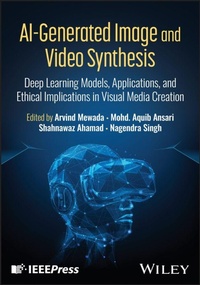
AI-Generated Image and Video Synthesis
Deep Learning Models, Applications, and Ethical Implications in Visual Media Creation
1st Edition
Will be published approx. on 19. October 2026
Book
Hardback
448 pages
978-1-394-40311-0 (ISBN)
Description
Technical depth and ethical frameworks for AI visual media synthesis
Generative AI models for visual media are transforming virtual reality and biomedical imaging while raising urgent questions about deepfakes and misinformation. AI-Generated Image and Video Synthesis addresses both dimensions. A team of researchers provide algorithmic foundations alongside detection strategies, authentication methods, and regulatory analysis.
Coverage spans text-to-image generation, image-to-image translation, video synthesis, neural rendering, and 3D-aware generation. The book examines AI applications in CT, MRI synthetic data augmentation, and virtual staining for biomedical contexts. Case studies explore AI-assisted filmmaking, music videos, and style transfer. A dedicated chapter forecasts emerging trends including diffusion-transformer hybrids and autonomous generative agents.
Readers will also find:
Comparative analyses of generative models including GANs, diffusion models, and transformers with implementation guidance and code repositories for hands-on experimentation
Deepfake detection strategies and digital content authentication techniques addressing misinformation, intellectual property rights, and emerging regulatory frameworks worldwide
Industry case studies demonstrating real-world deployments in creative industries, surveillance systems, education, and cultural preservation applications
Biomedical imaging applications covering synthetic data generation for CT and MRI, virtual staining techniques, and data augmentation strategies
Practical toolkits and online resources supporting implementation and evaluation of AI synthesis techniques across professional and academic contexts
Designed for AI researchers, computer vision engineers, and graduate students studying deep learning and image processing, this book connects theoretical principles with practical deployment. The combination of technical depth, application coverage, and ethical analysis makes it a comprehensive resource for professionals navigating AI-generated visual media.
Generative AI models for visual media are transforming virtual reality and biomedical imaging while raising urgent questions about deepfakes and misinformation. AI-Generated Image and Video Synthesis addresses both dimensions. A team of researchers provide algorithmic foundations alongside detection strategies, authentication methods, and regulatory analysis.
Coverage spans text-to-image generation, image-to-image translation, video synthesis, neural rendering, and 3D-aware generation. The book examines AI applications in CT, MRI synthetic data augmentation, and virtual staining for biomedical contexts. Case studies explore AI-assisted filmmaking, music videos, and style transfer. A dedicated chapter forecasts emerging trends including diffusion-transformer hybrids and autonomous generative agents.
Readers will also find:
Comparative analyses of generative models including GANs, diffusion models, and transformers with implementation guidance and code repositories for hands-on experimentation
Deepfake detection strategies and digital content authentication techniques addressing misinformation, intellectual property rights, and emerging regulatory frameworks worldwide
Industry case studies demonstrating real-world deployments in creative industries, surveillance systems, education, and cultural preservation applications
Biomedical imaging applications covering synthetic data generation for CT and MRI, virtual staining techniques, and data augmentation strategies
Practical toolkits and online resources supporting implementation and evaluation of AI synthesis techniques across professional and academic contexts
Designed for AI researchers, computer vision engineers, and graduate students studying deep learning and image processing, this book connects theoretical principles with practical deployment. The combination of technical depth, application coverage, and ethical analysis makes it a comprehensive resource for professionals navigating AI-generated visual media.
More details
Language
English
Place of publication
United States
Publishing group
John Wiley & Sons Inc
Target group
Professional and scholarly
ISBN-13
978-1-394-40311-0 (9781394403110)
Copyright in bibliographic data and cover images is held by Nielsen Book Services Limited or by the publishers or by their respective licensors: all rights reserved.
Schweitzer Classification
Persons
Arvind Mewada, PhD, is an Assistant Professor in the School of Computer Science Engineering and Technology at Bennett University, India. His research spans natural language processing, machine learning, and deep learning, with publications in Multimedia Tools and Applications and The Journal of Supercomputing.
Mohd. Aquib Ansari, PhD, is an Assistant Professor at Galgotias University, India. A UGC-NET qualified scholar and M.Tech. Gold Medalist, his research focuses on computer vision, image processing, and human-computer interaction, with advances in surveillance systems and gesture recognition.
Shahnawaz Ahamad, PhD, is an Assistant Professor at Bennett University, India. His expertise includes cloud computing security and machine learning. He reviews for IEEE Access, Elsevier, Springer, and Wiley, and authored Cloud Computing: An Industrial Approach.
Nagendra Singh, PhD, is Principal of Trinity College of Engineering and Technology in India. He has published over 42 international journal articles, 9 conference papers, 3 Indian patents, and 4 books, contributing actively to IEEE and Scopus-indexed publications.
Mohd. Aquib Ansari, PhD, is an Assistant Professor at Galgotias University, India. A UGC-NET qualified scholar and M.Tech. Gold Medalist, his research focuses on computer vision, image processing, and human-computer interaction, with advances in surveillance systems and gesture recognition.
Shahnawaz Ahamad, PhD, is an Assistant Professor at Bennett University, India. His expertise includes cloud computing security and machine learning. He reviews for IEEE Access, Elsevier, Springer, and Wiley, and authored Cloud Computing: An Industrial Approach.
Nagendra Singh, PhD, is Principal of Trinity College of Engineering and Technology in India. He has published over 42 international journal articles, 9 conference papers, 3 Indian patents, and 4 books, contributing actively to IEEE and Scopus-indexed publications.