

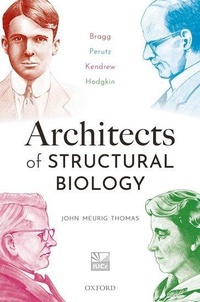
Architects of Structural Biology
Bragg, Perutz, Kendrew, Hodgkin
Published on 28. February 2020
Book
Hardback
322 pages
978-0-19-885450-0 (ISBN)
Description
Architects of Structural Biology is an amalgam of memoirs, biography, and intellectual history of the personalities and single-minded devotion of four scientists who are among the greatest in modern times. These three chemists and one physicist, all Nobel laureates, played a pivotal role in the creation of a new and pervasive branch of biology. This led in turn to major developments in medicine and to the treatment of diseases as a result of advances made in arguably one of the greatest centres of scientific research ever: the Laboratory of Molecular Biology in Cambridge, which they helped to establish. Their work and that of their predecessors at the Royal Institution in London reflects the broader cultural, scientific and educational strength of the UK from the early 19th century onwards. The book also illustrates the nurturing of academic life in the collegiate system, exemplified by the activities of, and cross-fertilization within, a small Cambridge college.
Reviews / Votes
An excellent book for all interested in the history of science. * Anders Liljas, IUCr Journal of Structural Biology * a fascinating behind-the-scenes journey of the early years of structural biology . . . The real insight of this book is not so much the stories of the four cited pioneers, but their interactions with a wide cast of people who founded the field. The commentary on different leadership styles is very acute, as well as the respectful telling of some of the personality clashes and rivalries that developed. This would be an excellent read for those who are beginning to specialise in structural biology, and those with a love of the history of crystallography. * Helen Maynard-Casely, IUCr Newsletter (2021) Volume 29(1) * beautifully written and illustrated . . . The science is clearly explained, without too much complex jargon. [Architects of Structural Biology] is a superb chronicle of an extraordinary era of scientific and medical advances * Arpan K. Banerjee, former Chairman of the British Society for the History of Radiology, Hektoen International * [John Meurig Thomas'] insight due to the close connections to the main people in the book gives a valuable perspective on how it was possible for an activity that began in a shed at a parking lot to develop into a world-leading laboratory . . . [he] makes some remarkable observations * Anders Liljas, Acta Crystallographica * For historians and philosophers of science, this book renews the debate of whether the personalities, teaching styles, and institutional support are as significant as the ideas, experiments, and publications that result from the untidy, often contradictory, ways in which they are generated. As I read this volume, I delighted in the amount of sharing and enthusiasm even rivals had for each other's work... * Elof Axel Carlson, Biochemistry & Cell Biology, Stony Brook University, The Quarterly Review of Biology * A superb exposition of many inter-related topics. The author is very articulate with a great talent for explaining in an approachable, perceptive and jargon-free manner the insights, interactions and key milestones. The book will be a popular, accessible portal into the hidden depths of molecular and biological structure as revealed during the last century. * Richard Henderson, Nobel Laureate, Cambridge University * This is a landmark book on the lives and work of four brilliant Nobel Prize-winning scientists, and many of their colleagues, whose pioneering research on structural biology has transformed modern medicine. [...] It should be read by a wide range of scientists, from pre-university students to professors and directors of research institutes. If you can only read one scientific book this year, read this one. * Sir Colin Humphreys, Director of Research, University of Cambridge * Biomedical research -- elucidating the chemistry of life - is now a massive enterprise. This book focuses on some key pioneering stages, when a conjunction of individuals initiated huge advances, through insight, instrumental skill and determination. [...] This superbly-written celebration of some great scientists and their achievements deserves wide readership. * Lord Martin Rees, Astronomer Royal and Former President of the Royal Society * [John Meurig Thomas'] vivid profiles ... illumine the field of structural biology and help explain how the Laboratory of Molecular Biology became one of the most successful and influential scientific establishments ever. * Lubert Stryer, Stanford University * Sir John has extraordinary aptitude for writing as well as for pursuing adventurous scientific studies. [...] The topic is indeed timely. Other books have bits and pieces but Sir John has brought together a saga of monumental discoveries. The book will inspire many young scientists and intrigue a wide readership. * Dudley Herschbach, , Nobel Laureate, Harvard University * The book is beautifully written and illustrated...This book is a history of the glory days of advances in molecular biology of the last century. The science is clearly explained, without too much complex jargon. It is a superb chronicle of an extraordinary era of scientific and medical advances made by scientists of outstanding talent, to whom we remain indebted. * Arpan Banerjee, Hektoen International Journal *More details
Language
English
Place of publication
Oxford
United Kingdom
Target group
Professional and scholarly
Product notice
sewn/stitched
Cloth over boards
Illustrations
45 grayscale and 36 color line figures, and 38 grayscale and 19 color halftone figures
Dimensions
Height: 241 mm
Width: 161 mm
Thickness: 25 mm
Weight
684 gr
ISBN-13
978-0-19-885450-0 (9780198854500)
Copyright in bibliographic data and cover images is held by Nielsen Book Services Limited or by the publishers or by their respective licensors: all rights reserved.
Schweitzer Classification
Other editions
Additional editions
E-Book
02/2020
1st Edition
OUP eBook
€44.99
Available for download
Person
Sir John Meurig Thomas is Former Director of the Royal Institution of Great Britain and the Davy-Faraday Research Laboratory, London, and former Master of Peterhouse. He was Head of the Department of Physical Chemistry and Professorial Fellow of King's College, University of Cambridge. John Meurig Thomas was knighted for services to chemistry and the popularisation of science. His biography of Michael Faraday has been translated into Japanese, Chinese and Italian. He has received numerous international and national awards for his work, including the Royal Medal of the Royal Society for his contributions to green chemistry and clean technology. He is a member of the American Academy of Arts and Science, and of the Swedish and Russian Academies of Sciences.
Author
Former Director of the Royal Institution of Great Britain and the Davy-Faraday Research Laboratory, London, and former Master of Peterhouse, and Head of the Department of Physical Chemistry and Professorial Fellow of King's College, University of...Former Director of the Royal Institution of Great Britain and the Davy-Faraday Research Laboratory, London, and former Master of Peterhouse, and Head of the Department of Physical Chemistry and Professorial Fellow of King's College, University of Cambridge,, University of Cambridge
Content
1: Max Perutz, John Kendrew, Peterhouse and the Davy-Faraday Research Laboratory
2: The Birth and Initial Exploitation of X-ray Diffraction
3: W. H. Bragg and his Creation of a World-Famous Centre for X-ray Crystallography at the Davy-Faraday Research Laboratory
4: A Dispute Between the Cavendish and Caltech: The Emergence and Ubiquity of the Alpha Helix
5: Perutz and Kendrew: The Heroic Era of Structural Molecular Biology
6: Sir Lawrence Bragg at the RI (1953-1966) and the Determination of the First Three-Dimensional Structure of an Enzyme at the DFRL (1965)
7: Lawrence Bragg and Linus Pauling: Comparisons and Rivalries
8: Biographical Sketches
9: Contributions of Cambridge College Life to Structural Biology: Peterhouse as an Exemplar
10: The Summing Up: The Astonishing Successes of the LMB, and the Dawn of a New Structural Biological Era
2: The Birth and Initial Exploitation of X-ray Diffraction
3: W. H. Bragg and his Creation of a World-Famous Centre for X-ray Crystallography at the Davy-Faraday Research Laboratory
4: A Dispute Between the Cavendish and Caltech: The Emergence and Ubiquity of the Alpha Helix
5: Perutz and Kendrew: The Heroic Era of Structural Molecular Biology
6: Sir Lawrence Bragg at the RI (1953-1966) and the Determination of the First Three-Dimensional Structure of an Enzyme at the DFRL (1965)
7: Lawrence Bragg and Linus Pauling: Comparisons and Rivalries
8: Biographical Sketches
9: Contributions of Cambridge College Life to Structural Biology: Peterhouse as an Exemplar
10: The Summing Up: The Astonishing Successes of the LMB, and the Dawn of a New Structural Biological Era