

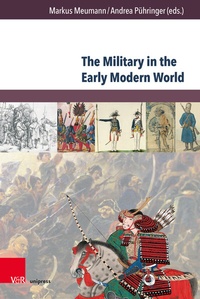
The Military in the Early Modern World
A Comparative Approach
1st Edition
Published on 14. December 2020
Book
Hardback
312 pages
978-3-8471-1013-2 (ISBN)
Description
When looking at the early modern period (c. 1500-c. 1800), we often speak of "the military" or "the army". But what exactly do we mean when using these terms? The forms and structures of the armed forces have not only changed between 1500 and 1800, but also varied throughout different regions of the world and even within Europe. The contributors to this volume examine twelve early modern examples of armed forces in the Holy Roman Empire, Western and Eastern Europe, Eastern Asia and North America and paint a multifarious and even disparate picture during this period. The findings suggest that modern notions of the armed forces common in the early modern period should be used more prudently to avoid prevalent implications of non-existing continuity and uniformity.
More details
Other editions
Additional editions
E-Book
12/2020
1st Edition
V&R unipress
€55.00
Available for download
Persons
Editor
Markus Meumann ist seit April 2026 kommissarischer Direktor des Forschungszentrums Gotha der Universität Erfurt.
Andrea Pühringer, Dr phil., is also a member of the »Arbeitskreis«. She held lectureships at the Universities of Vienna, Marburg, Kassel and Venice, Italy, and is now a freelance historian with a focus on earlymodern social, economic and cultural history.
Contributions
Ronald G. Asch ist Professor für Neuere Geschichte an der Universität Freiburg.
Prof. Dr. Hans-Jürgen Bömelburg, Historiker, ist Professor an der Justus-Liebig-Universität Gießen. Sein Forschungsgebiet ist die Geschichte Ostmitteleuropas.
Martin P. Schennach ist Professor für Rechtsgeschichte am Institut für Römisches Recht und Rechtsgeschichte der Universität Innsbruck, Mitglied des Instituts für Österreichische Geschichtsforschung.
Carmen Winkel ist Wissenschaftliche Mitarbeiterin am Lehrstuhl für Militärgeschichte der Universität Potsdam. Seit 2008 arbeitet sie als DFG-Stipendiatin an ihrer Dissertation zum Thema »Netzwerke und Patronage im preußischen Offizierkorps des 18. Jahrhunderts«.
Prof. Dr. Marian Füssel hat den Lehrstuhl für Frühe Neuzeit unter besonderer Berücksichtigung der Wissensgeschichte an der Universität Göttingen inne.