

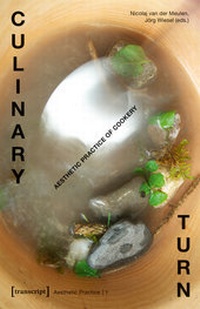
Culinary Turn
Aesthetic Practice of Cookery
1st Edition
Published on 15. May 2017
Book
Paperback/Softback
328 pages
978-3-8376-3031-2 (ISBN)
Description
Kitchen, cooking, nutrition, and eating have become omnipresent cultural topics. They stand at the center of design, gastronomy, nutrition science, and agriculture. Artists have appropriated cooking as an aesthetic practice - in turn, cooks are adapting the staging practices that go with an artistic self-image. This development is accompanied by crisis of eating behaviour and a philosophy of cooking as a speculative cultural technique. This volume investigates the dimensions of a new culinary turn, combining for the very first time contributions from the theory and practice of cooking.
Reviews / Votes
»Dass ästhetisches Leben nicht ohne ethische, moralische, politische und soziale, also humane Grundlagen möglich ist, vermitteln die Autorinnen und Autoren in überzeugender [...] Weise.« Jos Schnurer, www.socialnet.de, 31.05.2017 Besprochen in: hotelstyle & gastro, 12 (2016) www.zeit.de, 04.06.2017, Daniel SiggeMore details
Product info
Kt
Series
Language
English
Place of publication
Bielefeld
Germany
Target group
Professional and scholarly
Product notice
Unsewn / adhesive bound
Illustrations
durchgängig vierfarbig
Dimensions
Height: 24 cm
Width: 15.5 cm
Thickness: 2 mm
Weight
570 gr
ISBN-13
978-3-8376-3031-2 (9783837630312)
Schweitzer Classification
Other editions
Additional editions
E-Book
04/2017
1st Edition
transcript
€0.00
Available for download
Persons
Editor
Nicolaj van der Meulen (Prof. Dr.) is program director of the interdisciplinary teaching format »CoCreate« at the School of Art and Design at Fachhochschule Nordwestschweiz. His research focuses on culinary aesthetics, philosophy of food, and image theory and image literacy.
Jörg Wiesel (Prof. Dr.) is head of the Department of Fashion Design at the School of Art and Design at Fachhochschule Nordwestschweiz. He publishes on the history and theory of theater, piracy, the intermediality of film and fashion, and conducts research on culinary arts, cooking, and the economies of the aesthetic and broadcasting.
Assisted by