

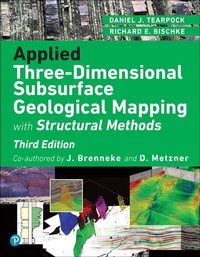
Applied Three-Dimensional Subsurface Geological Mapping: With Structural Methods
Description
Long recognized as the most authoritative, practical, and comprehensive guide to structural mapping methods, Applied Three-Dimensional Subsurface Geological Mapping, Third Edition, has been thoroughly updated to reflect recent technical developments, with an emphasis on shale play basins, horizontal drilling, unconventional resources, and modern workflows.
The authors of this edition have more than a century of collective experience in hydrocarbon exploration and development, in major, large, independent companies throughout the world. In this long-awaited update, they present revised and new chapters on computer mapping, shale basin exploration, and prospect reserves and risk. They introduce key innovations related to shale reservoirs, hydraulic fracturing, and deviated, horizontal, and directional wells, along with expanded discussions of computer interpretations and mapping.
Throughout, the book links theory and practice based on fundamental geoscience principles. These principles will help you integrate all available geological, geophysical, and engineering data, to generate more reasonable and viable subsurface interpretations, and to construct maps that successfully identify reserves.
- Master core principles and proven methods for accurate subsurface interpretations and mapping
- Construct subsurface maps and cross-sections from well logs, seismic sections, and outcrop data
- Work effectively with horizontal and directionally drilled wells and directional surveys
- Use powerful well log-correlation techniques
- Construct viable fault and horizon structure maps
- Balance and interpret compressional, extensional, and strike-slip structures
- Distinguish between the different structure styles and the characterization of growth structures
- Understand isochore and isopach maps
Register your book for convenient access to downloads, updates, and/or corrections as they become available. See inside book for details.
More details
Other editions
Additional editions
Previous edition
Persons
The late Daniel J. Tearpock was a noted scientist, teacher, and author of several popular applied books and papers on geological mapping. He was also an entrepreneur and led the international petroleum consultancy and training company Subsurface Consultants & Associates, LLC (SCA). He was the lead author of previous editions of this book and helped create the basics of correctly applied geological mapping technics and principles.
Richard E. Bischke, PhD , president of PCGS, has been involved with teams within major oil and gas companies that had discoveries from Louisiana and Venezuela to the Philippines. He has worked in 19 different countries and was previously chief exploration geophysicist at IntEx, LLC, and chief structural geophysicist for SCA.
James C. Brenneke is retired from Shell Oil (US), where he worked in research, exploration, and production; he also served in BP's deep-water Gulf of Mexico production organization. He now teaches SCA's Applied Subsurface Geological Mapping course.
David C. Metzner has interpreted thousands of square miles of 3D seismic data over a 38-year career exploring, characterizing, and developing petroleum reserves. He retired from Pioneer Natural Resources in 2019 and formed Crossroads Geoscience Solutions LLC, providing seismic interpretation, consulting, and mentoring services.
Content
- Chapter 1: Introduction to Subsurface Mapping
- Chapter 2: Contouring and Contouring Techniques
- Chapter 3: Directionally Drilled Wells and Directional Surveys
- Chapter 4: Log Correlation Techniques
- Chapter 5: Integration of Geophysical Data in Subsurface Mapping
- Chapter 6: Cross Sections
- Chapter 7: Fault Maps
- Chapter 8: Structure Maps
- Chapter 9: Interpretation of Three-Dimensional Seismic Data
- Chapter 10: Compressional Structures: Balancing and Interpretation
- Chapter 11: Extensional Structures: Balancing and Interpretation
- Chapter 12: Strike-Slip Faults and Associated Structures
- Chapter 13: Growth Structures
- Chapter 14: Isochore and Isopach Maps