

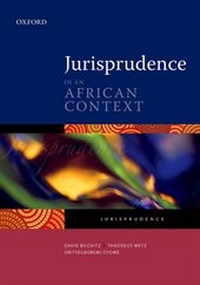
Jurisprudence in an African Context
Published on 15. August 2015
Book
Paperback/Softback
512 pages
978-0-19-904849-6 (ISBN)
Description
Jurisprudence in an African Context is devoted to the philosophy of law, in a way that engages earnestly with African thought and the African context. The text features primary texts by leading African intellectuals, putting these into critical dialogue with Western theorists. It addresses core jurisprudential topics, such as the nature and functions of law, the manner in which judges do and should interpret the law, theories of distributive justice, and accounts of civil and criminal justice. These abstract philosophical issues are considered in the context of salient controversies on the African continent, including: how cultural norms should influence judicial interpretation, who is obligated to fight poverty, how to effect land reform, whether to respond punitively to crimes against humanity, and, more broadly, how traditional values might inform contemporary thought and practice. Texts and topics are expounded and evaluated in a clear, accessible manner, and related questions guide readers to actively engage and respond. Jurisprudence in an African Context is suited as core material for courses in jurisprudence (including both legal and political philosophy), and may be of interest to scholars who wish to engage with African thought about the making, interpretation and enforcement of law.
More details
Language
English
Place of publication
Goodwood
South Africa
Target group
College/higher education
Professional and scholarly
Dimensions
Height: 240 mm
Width: 170 mm
Thickness: 15 mm
Weight
470 gr
ISBN-13
978-0-19-904849-6 (9780199048496)
Copyright in bibliographic data and cover images is held by Nielsen Book Services Limited or by the publishers or by their respective licensors: all rights reserved.
Schweitzer Classification
Content
- Part 1 - Theories of Law
- Chapter 1 - Jurisprudence in an African context: An introduction
- Chapter 2 - What is law? I: Positivism and traditional African societies
- Chapter 3 - What Is law? II: Naturalism and apartheid
- Chapter 4 - How should judges adjudicate in an African constitutional democracy?
- Chapter 5 - Is legal interpretation subjective?
- Part 2 - Theories of Justice
- Chapter 6 - What is a just distribution of resources?
- Chapter 7 - Who has duties flowing from justice?
- Chapter 8 - Who do rights protect?
- Chapter 9 - How do we rectify past injustices?
- Chapter 10 - Why punish the guilty?
- Chapter 11 - Concluding remarks about key philosophical distinctions
- Chapter 1 - Jurisprudence in an African context: An introduction
- Chapter 2 - What is law? I: Positivism and traditional African societies
- Chapter 3 - What Is law? II: Naturalism and apartheid
- Chapter 4 - How should judges adjudicate in an African constitutional democracy?
- Chapter 5 - Is legal interpretation subjective?
- Part 2 - Theories of Justice
- Chapter 6 - What is a just distribution of resources?
- Chapter 7 - Who has duties flowing from justice?
- Chapter 8 - Who do rights protect?
- Chapter 9 - How do we rectify past injustices?
- Chapter 10 - Why punish the guilty?
- Chapter 11 - Concluding remarks about key philosophical distinctions