

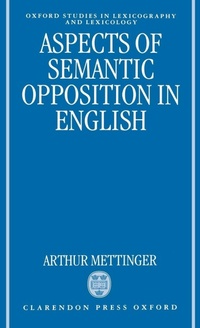
Aspects of Semantic Opposition in English
Published on 3. February 1994
Book
Hardback
214 pages
978-0-19-824269-7 (ISBN)
Description
Antonymy is recongized as an important type of meaning relation in natural languages, yet there are very few detailed empirical studies of the topic. Through an analysis of a corpus of 43 contemporary English-language novels Dr Mettinger isolates ten syntactic frames within which antonyms are regularly found: these serve as a useful heuristic tool for eliciting opposites from texts. He argues that there are two kinds of antonyms: systemic opposites which have meaning relations definable in strictly semantic terms, and non-systemic opposites which require contextual and encyclopaedic knowledge for an interpretation of their relationship.
The author analyses systemic opposites within an autonomous semantics framework based on semantic field theory, using semantic features, semantic dimensions, and archisememes as descriptive tools. His analysis of 350 pairs of antonyms taken from Roget's Thesaurus of English Words and Phrases yields a typology of meaning-opposition in English based on syntacticosemantic criteria such as gradability and scalarity which stands in contrast to standard logic-based typologies. Among the specific topics covered are `negative' prefixes, the problem of markedness, and the treatment of meaning-opposition from a cognitive point of view.
The author analyses systemic opposites within an autonomous semantics framework based on semantic field theory, using semantic features, semantic dimensions, and archisememes as descriptive tools. His analysis of 350 pairs of antonyms taken from Roget's Thesaurus of English Words and Phrases yields a typology of meaning-opposition in English based on syntacticosemantic criteria such as gradability and scalarity which stands in contrast to standard logic-based typologies. Among the specific topics covered are `negative' prefixes, the problem of markedness, and the treatment of meaning-opposition from a cognitive point of view.
Reviews / Votes
The lexical entries are highly useful...Anyone who has tried to present an explicit and detailed lexical semantic analysis will appreciate the care that has gone into these entries...Anyone who is interested in the organization of the lexicon and who has some background of antonymy will profit from this book...M has valuable hands-on experience which would be welcomed by readers who wish to become more effective empiricists * Lexicology * The lexical entries are highly useful...Anyone who has tried to present an explicit and detailed lexical analysis will appreciate the care that has gone into these entries...Anyone who is interested in the organisation of the lexicon and who has some background knowledge of antonymy will profit from this book...M has valuable hands-on experience which would be welcomed by readers who wish to become more effective empiricists * Lexicology *More details
Series
Language
English
Place of publication
Oxford
United Kingdom
Publishing group
Oxford University Press
Target group
Professional and scholarly
Dimensions
Height: 222 mm
Width: 145 mm
Thickness: 16 mm
Weight
442 gr
ISBN-13
978-0-19-824269-7 (9780198242697)
Copyright in bibliographic data and cover images is held by Nielsen Book Services Limited or by the publishers or by their respective licensors: all rights reserved.
Schweitzer Classification
Person
Content
Part 1 "Antonymy" - scope and delimitations: some remarks on the state of the art; semantic opposition - two "againsts"; adversivity, oppositeness of meaning and contrast. Part 2 Contrast: opposites in context - basic assumptions; opposites in context - corpus. Part 3 Semantic oppostion - systemic versus non-systemic: systemic semantic opposition; non-systemic opposition. Part 4 Oppositeness of meaning - basic assumptions: central oppositeness of meaning. Part 5 Central oppositeness of meaning - analyses: digital opposites; scalar opposites. Part 6 Central oppositeness of meaning - some further issues: oppositeness of meaning versus negation; the problem of markedness; some remaining problems. Appendices: opposites in context - index of sources; the "Roget's Thesaurus" corpus.