

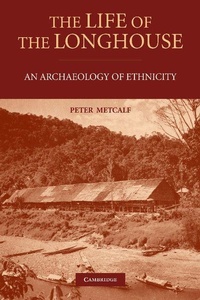
The Life of the Longhouse
An Archaeology of Ethnicity
Published on 13. September 2012
Book
Paperback/Softback
358 pages
978-1-107-40756-5 (ISBN)
Description
For two centuries, travellers were amazed at the massive buildings found along the rivers that flow from the mountainous interior of Borneo. They concentrated hundreds of people under one roof, in the middle of empty rainforests. There was no practical necessity for this arrangement, and it remains a mystery. In this book Peter Metcalf provides an answer by showing the historical context, using both oral histories and colonial records. The key factor was a pre-modern trading system that funneled rare and exotic jungle products to China via the ancient coastal city of Brunei. Meanwhile the elite manufactured goods traded upriver shaped the political and religious institutions of longhouse society. However, the apparent permanence of longhouses was an illusion. In historical terms, longhouse communities were both mobile and labile, and the patterns of ethnicity they created more closely resemble the contemporary world than any stereotype of 'tribal' societies.
More details
Language
English
Place of publication
Cambridge
United Kingdom
Target group
Professional and scholarly
Product notice
Paperback (trade)
Dimensions
Height: 229 mm
Width: 152 mm
Thickness: 19 mm
Weight
519 gr
ISBN-13
978-1-107-40756-5 (9781107407565)
Copyright in bibliographic data and cover images is held by Nielsen Book Services Limited or by the publishers or by their respective licensors: all rights reserved.
Schweitzer Classification
Other editions
Additional editions
E-Book
12/2009
1st Edition
Cambridge University Press
€42.99
Available for download
Book
12/2009
Cambridge University Press
€89.10
Shipment within 15-20 days
Person
Content
Introduction: the problem: ethnicity and community; Part I. Longhouses: 1. Longhouses; 2. Longhouse communities; 3. The coming of the Brooke Raj; Part II. Longhouses and Leaders: 4. Aban Jau's career; 5. Aban Jau's successors; Part III. Longhouses and Trade: 6. The sultan's fence; 7. Pre-modern upriver trade; Part IV. Longhouse Populations: 8. The linguistic data; 9. Disease, slavery, assimilation, annihilation; Part V. Longhouses and Ritual: 10. The ritual consensus; 11. The ritual operator; 12. The impresarios of the ancestors; Part VI. Longhouses and the State: 13. Longhouses during the Raj; 14. Longhouses after the Raj; Conclusion: the general and the particular.