

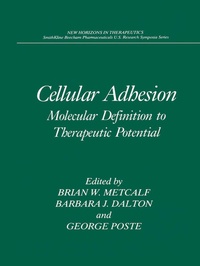
Cellular Adhesion
Molecular Definition to Therapeutic Potential
Published on 25. September 2012
Book
Paperback/Softback
XXI, 318 pages
978-1-4613-6050-6 (ISBN)
Description
This volume focuses on recent developments in our understanding of selected adhesion processes that may offer new approaches to developing therapeutics for a variety ofdiseases. The volume first introduces the molecules involved in key adhesive processes, then describes the biological consequences of several adhe- sive interactions, and closes with a description of the initial therapeutic ap- proaches to antagonizing. adhesion. These papers were originally presented at the SmithKline Beecham Pharmaceuticals Seventh U. S. Research Symposium held in Philadelphia in October of 1992. ofacell to asurface. In its simplestsense, cellularadhesion is the adherence The cells of interest in the context of this volume are bacterial and mammalian, with an emphasis on leukocytes; surfaces can be other cells and tissues (such as bone), matrix proteins, or inanimate objects such as in-dwelling medical devices and catheters. Interaction between adhesion molecules usually results in a spe- cific biological response. Adhesion is a form ofcellularcommunication, and represents the way a cell senses its environment through contact.
Like hormones and cytokines, the sol- uble mediators used by cells for communication, adhesion molecules are defined molecular entities that recognize specific receptor structures on the surface to which they adhere. Recent activity has focused on defining the structure of the individual molecules responsible for many types ofcellularadhesion. New adhe- sion proteins are being cloned with the help of specific antibodies and precise functional assays.
Like hormones and cytokines, the sol- uble mediators used by cells for communication, adhesion molecules are defined molecular entities that recognize specific receptor structures on the surface to which they adhere. Recent activity has focused on defining the structure of the individual molecules responsible for many types ofcellularadhesion. New adhe- sion proteins are being cloned with the help of specific antibodies and precise functional assays.
More details
Series
Edition
Softcover reprint of the original 1st ed. 1994
Language
English
Place of publication
New York
United States
Target group
Professional and scholarly
Research
Product notice
Paperback (trade)
Unsewn / adhesive bound
Illustrations
XXI, 318 p.
Dimensions
Height: 280 mm
Width: 210 mm
Thickness: 19 mm
Weight
852 gr
ISBN-13
978-1-4613-6050-6 (9781461360506)
DOI
10.1007/978-1-4615-2466-3
Schweitzer Classification
Other editions
Additional editions
Brian W. Metcalf | Barbara J. Dalton | George Poste
Cellular Adhesion
Molecular Definition to Therapeutic Potential
E-Book
11/2013
Springer
€96.29
Available for download
Brian W. Metcalf | Barbara J. Dalton | George Poste
Cellular Adhesion
Molecular Definition to Therapeutic Potential
Book
07/1994
Kluwer Academic/Plenum Publishers
€106.99
Shipment within 10-15 days
Persons
Content
I. Molecular Definition-Adhesion Molecule Structure and Function.- 1 The Biological Function of ?3 Integrins and Other Vitronectin Receptors.- 2 Integrin Modulating Factor and the Regulation of Leukocyte Integrins.- 3 Structure-Function Aspects of Selectin-Carbohydrate Interactions.- 4 Recognition of Cell Surface Carbohydrates by C-Type Animal Lectins.- 5 The Uvomorulin-Catenin Complex: Insights into the Structure and Function of Cadherins.- 6 Cytotactin: A Substrate Adhesion Molecule with Amphitropic Functions in Morphogenesis.- 7 Adhesion Molecules and Bone Remodeling.- II. Biological Consequences of Cellular Adhesion.- 8 Effects of Shear Stress on Leukocyte Adhesion.- 9 Blockade of Leukocyte Adhesion in in Vivo Models of Inflammation.- 10 Proadhesive Cytokine Immobilized on Endothelial Proteoglycan: A New Paradigm for Recruitment of T Cells.- 11 Lung Inflammation and Adhesion Molecules.- 12 Adhesion Molecule-Dependent Cardiovascular Injury.- 13 GPIIb/IIIa Antagonists as Novel Antithrombotic Drugs: Potential Therapeutic Applications.- III. Targeting Adhesion Molecules-Therapeutic Potential.- 14 The Pathological Consequences of Bacterial Adhesion to Medical Devices: A Practical Solution to the Problem of Device-Related Infections.- 15 Peptide Mimetics as Adhesion Molecule Antagonists.- 16 Derivation of Therapeutically Active Humanized and Veneered Anti-CD18 Antibodies.