

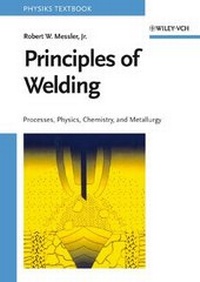
Principles of Welding
Processes, Physics, Chemistry, and Metallurgy
Published on 23. April 1999
Book
Hardback
XXIII, 662 pages
978-0-471-25376-1 (ISBN)
Description
An advanced yet accessible treatment of the welding process and its underlying science.
Despite the critically important role welding plays in nearly every type of human endeavor, most books on this process either focus on basic technical issues and leave the science out, or vice versa. In Principles of Welding, industry expert and prolific technical speaker Robert W. Messler, Jr. takes an integrated approach--presenting a comprehensive, self-contained treatment of the welding process along with the underlying physics, chemistry, and metallurgy of weld formation.
Promising to become the standard text and reference in the field, this book provides an unprecedented broad coverage of the underlying physics and the mechanics of solidification--including peritectic and eutectic reactions--and emphasizes material continuity and bonding as a way to create a joint between materials of the same general class. The author supplements the book with hundreds of tables and illustrations, and correlates the science to welding practices in the real world.
Principles of Welding departs from existing books with its clear, unambiguous presentation, which is easily grasped even by undergraduate students, yet given at the advanced level required by experienced engineers.
Despite the critically important role welding plays in nearly every type of human endeavor, most books on this process either focus on basic technical issues and leave the science out, or vice versa. In Principles of Welding, industry expert and prolific technical speaker Robert W. Messler, Jr. takes an integrated approach--presenting a comprehensive, self-contained treatment of the welding process along with the underlying physics, chemistry, and metallurgy of weld formation.
Promising to become the standard text and reference in the field, this book provides an unprecedented broad coverage of the underlying physics and the mechanics of solidification--including peritectic and eutectic reactions--and emphasizes material continuity and bonding as a way to create a joint between materials of the same general class. The author supplements the book with hundreds of tables and illustrations, and correlates the science to welding practices in the real world.
Principles of Welding departs from existing books with its clear, unambiguous presentation, which is easily grasped even by undergraduate students, yet given at the advanced level required by experienced engineers.
More details
Edition
1. Auflage
Language
English
Place of publication
United States
Publishing group
John Wiley & Sons Inc
Target group
College/higher education
Professional and scholarly
Illustrations
354
354 s/w Abbildungen
Dimensions
Height: 24 cm
Width: 17 cm
Thickness: 5 cm
Weight
1466 gr
ISBN-13
978-0-471-25376-1 (9780471253761)
Schweitzer Classification
Other editions
New editions
Book
07/2024
1st Edition
Wiley-Blackwell
€268.64
Shipment within 5-7 days
Additional editions
E-Book
09/2008
1st Edition
Wiley-VCH
€241.99
Available for download
Person
ROBERT W. MESSLER, JR., PhD, FASM, FAWS, is Associate Professor and Director of the Warren F. Savage Materials Joining Laboratory at Rensselaer Polytechnic Institute in Troy, New York. With over three decades in diverse areas of advanced materials and processes in industry and academia, Professor Messler has published numerous papers on welding, brazing, soldering, and innovative integral fastening as well as the book Joining of Advanced Materials.
Content
THE PROCESS AND PROCESSES OF WELDING.
Introduction to the Process of Welding.
Classifying Welding Processes.
Fusion Welding Processes.
Nonfusion Welding Processes.
THE PHYSICS OF WELDING.
Energy for Welding.
The Flow of Heat in Welds.
Thermally Induced Distortion and Residual Stresses During Welding.
The Physics of Welding Energy or Power Sources.
Molten Metal Transfer in Consumable Electrode Arc Welding.
Weld Pool Convection, Oscillation, and Evaporation.
THE CHEMISTRY OF WELDING.
Molten Metal and Weld Pool Reactions.
Weld Chemical Heterogeneity.
THE METALLURGY OF WELDING.
Weld Fusion Zone Solidification.
Eutectic, Peritectic, and Postsolidification Fusion Zone Transformations.
The Partially Melted Zone.
The Weld Heat-Affected Zone.
Weldability and Weld Testing.
Closing Thoughts.
Appendices.
Index.
Introduction to the Process of Welding.
Classifying Welding Processes.
Fusion Welding Processes.
Nonfusion Welding Processes.
THE PHYSICS OF WELDING.
Energy for Welding.
The Flow of Heat in Welds.
Thermally Induced Distortion and Residual Stresses During Welding.
The Physics of Welding Energy or Power Sources.
Molten Metal Transfer in Consumable Electrode Arc Welding.
Weld Pool Convection, Oscillation, and Evaporation.
THE CHEMISTRY OF WELDING.
Molten Metal and Weld Pool Reactions.
Weld Chemical Heterogeneity.
THE METALLURGY OF WELDING.
Weld Fusion Zone Solidification.
Eutectic, Peritectic, and Postsolidification Fusion Zone Transformations.
The Partially Melted Zone.
The Weld Heat-Affected Zone.
Weldability and Weld Testing.
Closing Thoughts.
Appendices.
Index.