

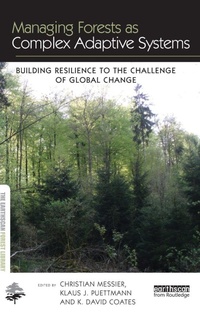
Managing Forests as Complex Adaptive Systems
Building Resilience to the Challenge of Global Change
1st Edition
Published on 22. January 2013
Book
Hardback
368 pages
978-0-415-51977-9 (ISBN)
Description
This book links the emerging concepts of complexity, complex adaptive system (CAS) and resilience to forest ecology and management. It explores how these concepts can be applied in various forest biomes of the world with their different ecological, economic and social settings, and history. Individual chapters stress different elements of these concepts based on the specific setting and expertise of the authors. Regions and authors have been selected to cover a diversity of viewpoints and emphases, from silviculture and natural forests to forest restoration, and from boreal to tropical forests.
The chapters show that there is no single generally applicable approach to forest management that applies to all settings. The first set of chapters provides a global overview of how complexity, CAS and resilience theory can benefit researchers who study forest ecosystems. A second set of chapters provides guidance for managers in understanding how these concepts can help them to facilitate forest ecosystem change and renewal (adapt or self-organize) in the face of global change while still delivering the goods and services desired by humans. The book takes a broad approach by covering a variety of forest biomes and the full range of management goals from timber production to forest restoration to promote the maintenance of biodiversity, quality of water, or carbon storage.
The chapters show that there is no single generally applicable approach to forest management that applies to all settings. The first set of chapters provides a global overview of how complexity, CAS and resilience theory can benefit researchers who study forest ecosystems. A second set of chapters provides guidance for managers in understanding how these concepts can help them to facilitate forest ecosystem change and renewal (adapt or self-organize) in the face of global change while still delivering the goods and services desired by humans. The book takes a broad approach by covering a variety of forest biomes and the full range of management goals from timber production to forest restoration to promote the maintenance of biodiversity, quality of water, or carbon storage.
Reviews / Votes
'Enhanced throughout with bibliographic references, tables and figures, and a comprehensive index, Managing Forests as Complex Adaptive Systems: Building Resilience to the Challenge of Global Change offers a seminal body of work and is highly recommended for professional, governmental, NGO, and academic library Environmental Studies and Forest Management Studies reference collections and supplemental reading lists.' - The Midwest Book Review, April 2013More details
Series
Language
English
Place of publication
London
United Kingdom
Publishing group
Taylor & Francis Ltd
Target group
College/higher education
Professional and scholarly
Postgraduate and Professional
Illustrations
65 s/w Abbildungen
65 Illustrations, black and white
Dimensions
Height: 240 mm
Width: 161 mm
Thickness: 24 mm
Weight
716 gr
ISBN-13
978-0-415-51977-9 (9780415519779)
Copyright in bibliographic data and cover images is held by Nielsen Book Services Limited or by the publishers or by their respective licensors: all rights reserved.
Schweitzer Classification
Other editions
Additional editions
Christian Messier | Klaus J. Puettmann | K. David Coates
Managing Forests as Complex Adaptive Systems
Building Resilience to the Challenge of Global Change
Book
04/2014
1st Edition
Routledge
€79.30
Shipment within 10-20 days
Christian Messier | Klaus J. Puettmann | K. David Coates
Managing Forests as Complex Adaptive Systems
Building Resilience to the Challenge of Global Change
E-Book
02/2013
1st Edition
Routledge
€72.49
Available for download
Christian Messier | Klaus J. Puettmann | K. David Coates
Managing Forests as Complex Adaptive Systems
Building Resilience to the Challenge of Global Change
E-Book
02/2013
1st Edition
Routledge
€72.49
Available for download
Persons
Christian Messier is Scientific Director of the Institute of Temperate Forest Sciences (ISFORT), Universite du Quebec en Outaouais, Quebec, Canada. His research interests are broad, ranging from the life cycle of trees to developing decision-making tools to better manage large forest holdings. His research has brought him to study various biomes across the world. He holds a research chair on tree growth, and has published more than 150 referee journal papers and book chapters.
Klaus J. Puettmann is Edmund Hayes Professor in Silviculture Alternatives in the Department of Forest Ecosystems and Society, Oregon State University, USA. He has been working on numerous projects related to regeneration and stand density management, with a special focus on utilizing a better understanding of ecological relationships in developing new silvicultural approaches. He works in cooperation with scientists from Europe and North America, and has published more than 60 referee journal articles in North American and European forestry and ecology journals.
K. David Coates is a senior Research Silviculturist with the Ministry of Natural Resource Operations in Smithers, Canada. He has 30 years of experience in research and silvicultural application in northern British Columbia including at least 50 scientific and technical publications.
Klaus J. Puettmann is Edmund Hayes Professor in Silviculture Alternatives in the Department of Forest Ecosystems and Society, Oregon State University, USA. He has been working on numerous projects related to regeneration and stand density management, with a special focus on utilizing a better understanding of ecological relationships in developing new silvicultural approaches. He works in cooperation with scientists from Europe and North America, and has published more than 60 referee journal articles in North American and European forestry and ecology journals.
K. David Coates is a senior Research Silviculturist with the Ministry of Natural Resource Operations in Smithers, Canada. He has 30 years of experience in research and silvicultural application in northern British Columbia including at least 50 scientific and technical publications.
Content
1. Managing Forests as Complex Adaptive Systems: Introductory Concepts and Applications 2. An Introduction to Complexity Science 3. Tropical Forests as Complex Adaptive Systems 4. Complexity in Temperate Forest Dynamics 5. Exploring Complexity in Boreal Forests 6. Forest Restoration in a Changing World: Complexity and Adaptation Examples from the Great Lakes Region of North America 7. Meta-networks of Fungi, Fauna and Flora as Agents of Complex Adaptive Systems 8. Complexity Confronting Tropical Silviculturists 9. Is Close-to-Nature Forest Management in Europe Compatible with Managing Forests as Complex Adaptive Forest Ecosystems? 10. Mediterranean Forests: Human Use And Complex Adaptive Systems 11. Fennoscandian Boreal Forests as Complex Adaptive Systems: Properties, Management Challenges and Opportunities 12. Management of Tasmanian Eucalypt Forests as Complex Adaptive Systems 13. Managing Tree Plantations as Complex Adaptive Systems 14. A New Integrative Framework for Understanding and Managing the World Forest: The Complex Adaptive System