

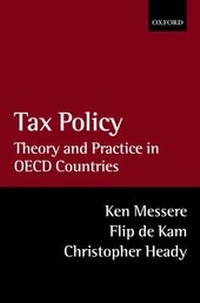
Tax Policy
Theory and Practice in OECD Countries
Published on 15. May 2003
Book
Hardback
280 pages
978-0-19-924148-4 (ISBN)
Description
How do governments justify their choice of tax policy? What are the arguments for and against the choices they make? Are there common trends in the tax policy choices of OECD countries? This book provides a unique guide to tax policies pursued by the governments of OECD countries by assessing recent policies, offering a thorough critique of their justification and looking at actual examples of policy choice.
The authors give an overview of post-war tax developments, addressing in detail topics such as the dynamics of tax revenues and public sector developments. They go on to examine the arguments for and against governments' main tax policy choices, looking at personal income tax, social security contributions, business taxes, consumption taxation and taxes on wealth, capital gains, and property. They rigorously examine arguments used by governments to justify certain policy choices, providing an objective evaluation of both the valid and invalid arguments for the choices made with regard to domestic taxation.
In addition to a thorough critique of recent tax policies, the book looks at the actual tax choices of 25 of the thirty OECD countries and aims to identify the similarities and the differences between them. The authors draw on these real examples and on their considerable experience in assessing possibilities for future tax systems.
The book will be of special interest to academics and students in the field of public finance, national and international tax policymakers, politicians, and journalists.
The authors give an overview of post-war tax developments, addressing in detail topics such as the dynamics of tax revenues and public sector developments. They go on to examine the arguments for and against governments' main tax policy choices, looking at personal income tax, social security contributions, business taxes, consumption taxation and taxes on wealth, capital gains, and property. They rigorously examine arguments used by governments to justify certain policy choices, providing an objective evaluation of both the valid and invalid arguments for the choices made with regard to domestic taxation.
In addition to a thorough critique of recent tax policies, the book looks at the actual tax choices of 25 of the thirty OECD countries and aims to identify the similarities and the differences between them. The authors draw on these real examples and on their considerable experience in assessing possibilities for future tax systems.
The book will be of special interest to academics and students in the field of public finance, national and international tax policymakers, politicians, and journalists.
More details
Language
English
Place of publication
Oxford
United Kingdom
Target group
Professional and scholarly
Illustrations
numerous figures and tables
Dimensions
Height: 241 mm
Width: 162 mm
Thickness: 20 mm
Weight
577 gr
ISBN-13
978-0-19-924148-4 (9780199241484)
Copyright in bibliographic data and cover images is held by Nielsen Book Services Limited or by the publishers or by their respective licensors: all rights reserved.
Schweitzer Classification
Persons
Ken Messere was formerly Head of the Fiscal Affairs Division at the Organisation for Economic Cooperation and Development (OECD), before becoming a member of the Ruding Committee advising on business taxes in EU countries. He has acted as a consultant for the OECD, the IMF and the World Bank. His previous books include Tax Policies in OECD Countries: Choices and Conflicts (IBFD 1993), and The Tax System in Industrialised Countries (OUP 1998).
Flip de Kam is a tax lawyer with a strong interest in the economics of the public sector. After a career in the civil service he was appointed Professor of Public Finance at Groningen University in 1988, and has also served as Head of the Tax Analysis Unit at the OECD Centre for Tax Policy and Administration from 1997 to 1999.
Christopher Heady is currently Head of the Tax Policy and Statistics Division at the OECD. He is an economist who has worked extensively on tax policy issues in both developed and developing countries, having been an Assistant Professor at Yale, a Lecturer then Reader at University College London and Professor of Applied Economics at the University of Bath. His previous books include Poverty and Social Exclusion in Europe (Edward Elgar 2002) and Fiscal Management and Economic Reform in the People's Republic of China (OUP 1995).
Flip de Kam is a tax lawyer with a strong interest in the economics of the public sector. After a career in the civil service he was appointed Professor of Public Finance at Groningen University in 1988, and has also served as Head of the Tax Analysis Unit at the OECD Centre for Tax Policy and Administration from 1997 to 1999.
Christopher Heady is currently Head of the Tax Policy and Statistics Division at the OECD. He is an economist who has worked extensively on tax policy issues in both developed and developing countries, having been an Assistant Professor at Yale, a Lecturer then Reader at University College London and Professor of Applied Economics at the University of Bath. His previous books include Poverty and Social Exclusion in Europe (Edward Elgar 2002) and Fiscal Management and Economic Reform in the People's Republic of China (OUP 1995).
Content
PART I: TAX TRENDS OF THE TWENTIETH CENTURY; PART II: THE DESIGN OF TAXES; PART III: TAX POLICY IN PRACTICE