

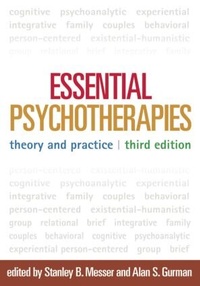
Essential Psychotherapies, Third Edition
Theory and Practice
3rd Edition
Published on 6. December 2013
Book
Paperback/Softback
516 pages
978-1-4625-1354-3 (ISBN)
Description
The leading survey text for basic psychotherapy courses, this book offers authoritative, engaging presentations of the 12 most important forms of psychotherapy practiced today. Prominent experts cover traditional treatments as well as influential models that have been developed relatively recently, giving students and practitioners a solid grasp of foundational theories, techniques, and research. Each chapter follows a common set of organizational guidelines; features illustrative vignettes and a full case example; and concludes with readings and resources to guide further study.
New to This Edition
*Incorporates the latest clinical developments and research.
*Chapter on ""third-wave"" behavior therapies.
*Each chapter has expanded discussions of the role of the therapeutic relationship and the use of evidence-based practices.
*Concise chapters make the book even more instructor and student friendly.
New to This Edition
*Incorporates the latest clinical developments and research.
*Chapter on ""third-wave"" behavior therapies.
*Each chapter has expanded discussions of the role of the therapeutic relationship and the use of evidence-based practices.
*Concise chapters make the book even more instructor and student friendly.
Reviews / Votes
"Essential Psychotherapies is a classic. In the third edition, Messer and Gurman have once again accomplished their goal of providing a thorough exposition of the most important approaches of our field. The chapters are written by foremost authors who cover the waterfront from treatments with deep historical roots (such as dynamic and humanistic approaches) to those associated with empirical traditions (such as behavioral and cognitive-behavioral approaches), as well as those at the cutting edge (such as third-wave behavioral treatments). There is no more comprehensive and informative volume on this topic. It is the definitive resource for psychotherapy theories courses."--Bruce E. Wampold, PhD, ABPP, Department of Counseling Psychology, University of Wisconsin-Madison"All students, regardless of their theoretical preferences, need to be well versed in the major models of psychotherapy practice. Clinical training faculty have come to depend on this text to provide the essential information about each major model. In the third edition, Messer and Gurman demonstrate their awareness of evolving models by including a chapter on mindfulness, acceptance, and other 'third-wave' behavioral therapies. Instructors will enthusiastically choose this book as a primary text for their classes on psychotherapy theories."--JoEllen Patterson, PhD, LMFT, Department of Counseling and Marital and Family Therapy, University of San Diego; Divisions of Family Medicine, Psychiatry, and Global Health, University of California, San Diego
"This book has become a classic in the field. The editors provide an organizational framework for each chapter that makes it easy to compare the therapies. Each chapter presents a different therapy approach, including integrative therapies, and covers both theory and practice, with an extended case example and a section on research. This is an invaluable text for undergraduate and graduate courses on psychotherapy; in my experience, it has been very well received by students. It is one of the best psychotherapy resources I have come across in a long time."--Hal Arkowitz, PhD, Department of Psychology, University of Arizona
"This book offers a round-the-world tour of psychotherapy for both the student and the experienced practitioner. Chapters by distinguished experts reveal the breadth of the field, highlighting controversies, underlining similarities, taking on sacred cows, and celebrating traditions. Undergraduate teachers, graduate seminar leaders, and training directors will value the structure and clarity of the book as it tackles thorny, unresolved issues of relationship versus technique, integration versus specific models, and the nature of empirical support."--Richard F. Summers, MD, Co-Director of Residency Training, Department of Psychiatry, University of Pennsylvania School of Medicine
More details
Edition
3rd edition
Language
English
Place of publication
New York
United States
Publishing group
Guilford Publications
Target group
College/higher education
Dimensions
Height: 254 mm
Width: 178 mm
Weight
880 gr
ISBN-13
978-1-4625-1354-3 (9781462513543)
Copyright in bibliographic data and cover images is held by Nielsen Book Services Limited or by the publishers or by their respective licensors: all rights reserved.
Schweitzer Classification
Other editions
New editions
Alan S. Gurman | Stanley B. Messer | Nadine J. Kaslow
Essential Psychotherapies, Fourth Edition
Theory and Practice
Book
12/2019
4th Edition
Guilford Press
€68.50
Shipment within 15-20 days
Additional editions
Book
06/2011
3rd Edition
Guilford Publications
€106.65
Article exhausted; check for reprint
Person
Stanley B. Messer, PhD, is Dean of the Graduate School of Applied and Professional Psychology at Rutgers, The State University of New Jersey, where he was Chairperson of the Department of Clinical Psychology for 9 years. He is interested in the application of psychodynamic theory and research to the brief and integrative therapies and has contributed to the debate on evidence-based practice. The author or editor of a number of books and many articles and book chapters, Dr. Messer is currently Associate Editor of the online journal Pragmatic Case Studies in Psychotherapy and serves on several other editorial boards. He is an American Psychological Association Fellow in the Society of Clinical Psychology, the Society of Theoretical and Philosophical Psychology, and the Society for the Advancement of Psychotherapy. Dr. Messer maintains a private practice in Highland Park, New Jersey. Alan S. Gurman, PhD, until his death in 2013, was Emeritus Professor of Psychiatry at the University of Wisconsin School of Medicine and Public Health in Madison. A pioneer in the development of integrative approaches to couple therapy, he edited and wrote many influential books; was a past two-term editor of the Journal of Marital and Family Therapy; and was former President of the Society for Psychotherapy Research. Dr. Gurman received numerous awards for his contributions to couple and family therapy, including the Distinguished Achievement in Family Therapy Research Award from the American Family Therapy Academy and the Distinguished Contribution to Family Psychology Award from the American Psychological Association. He also received the Award for Distinguished Achievement in Teaching and Training from the Association of Psychology Postdoctoral and Internship Centers.
Content
I. INTRODUCTION 1. Contemporary Issues in Psychotherapy Theory, Practice, and Research: A Framework for Comparative Study, Stanley B. Messer and Alan S. GurmanII. PSYCHOANALYTIC APPROACHES 2. Contemporary Freudian Psychoanalytic Psychotherapy, David L. Wolitzky
3. Relational Psychoanalytic Psychotherapy, Rebecca Coleman Curtis and Irwin HirschIII. BEHAVIORAL AND COGNITIVE APPROACHES 4. Behavior Therapy: Traditional Approaches, Martin M. Antony and Lizabeth Roemer
5. Cognitive Therapy, Kimberly A. Dienes, Susan Torres-Harding, Mark A. Reinecke, Arthur Freeman, and Ann Sauer
6. Behavior Therapy: Functional-Contextual Approaches, William C. Follette and Glenn M. CallaghanIV. EXPERIENTIAL AND HUMANISTIC APPROACHES 7. Person-Centered Psychotherapy and Related Experiential Approaches, Arthur C. Bohart and Jeanne C. Watson
8. Existential-Humanistic Psychotherapies, Kirk J. SchneiderVI. SYSTEMS-ORIENTED APPROACHES 9. Family Therapies, Nadine J. Kaslow, Jeshmin Bhaju, and Marianne P. Celano
10. Couple Therapies, Alan S. GurmanVII. OTHER INFLUENTIAL MODELS OF THERAPEUTIC PRACTICE 11. Brief Psychotherapies, Michael F. Hoyt
12. Integrative Approaches to Psychotherapy, George Stricker and Jerry Gold
13. Group Psychotherapies, Virginia Brabender
3. Relational Psychoanalytic Psychotherapy, Rebecca Coleman Curtis and Irwin HirschIII. BEHAVIORAL AND COGNITIVE APPROACHES 4. Behavior Therapy: Traditional Approaches, Martin M. Antony and Lizabeth Roemer
5. Cognitive Therapy, Kimberly A. Dienes, Susan Torres-Harding, Mark A. Reinecke, Arthur Freeman, and Ann Sauer
6. Behavior Therapy: Functional-Contextual Approaches, William C. Follette and Glenn M. CallaghanIV. EXPERIENTIAL AND HUMANISTIC APPROACHES 7. Person-Centered Psychotherapy and Related Experiential Approaches, Arthur C. Bohart and Jeanne C. Watson
8. Existential-Humanistic Psychotherapies, Kirk J. SchneiderVI. SYSTEMS-ORIENTED APPROACHES 9. Family Therapies, Nadine J. Kaslow, Jeshmin Bhaju, and Marianne P. Celano
10. Couple Therapies, Alan S. GurmanVII. OTHER INFLUENTIAL MODELS OF THERAPEUTIC PRACTICE 11. Brief Psychotherapies, Michael F. Hoyt
12. Integrative Approaches to Psychotherapy, George Stricker and Jerry Gold
13. Group Psychotherapies, Virginia Brabender