

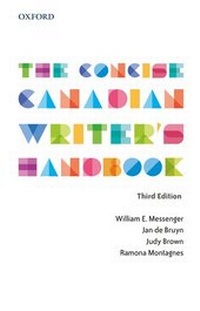
The Concise Canadian Writer's Handbook
3rd Edition
Published on 25. May 2017
Book
Spiral bound
528 pages
978-0-19-902109-3 (ISBN)
Description
The Concise Canadian Writer's Handbook is a streamlined version of the well-established Canadian Writer's Handbook. This handbook features the accessible, well-organized structure of the full volume, including descriptions and examples of the entire writing process: from basic grammar to constructing sentences and paragraphs, pre-writing, composing, proofreading, and editing. The text is suitable for students of all levels of study and includes EAL
icons that point to material of particular benefit to students learning English as an additional language.
This new edition features an updated and expanded documentation section that includes more citations for online sources, as well as colour coding to help students recognize the common elements among in-text and reference citations.
icons that point to material of particular benefit to students learning English as an additional language.
This new edition features an updated and expanded documentation section that includes more citations for online sources, as well as colour coding to help students recognize the common elements among in-text and reference citations.
Reviews / Votes
"The major strengths of this text are its ease of use and its conciseness. . . . I would not consider any other text for use in any course that covers the fundamentals of writing."--Cindy Soldan, Lakehead University
"This is a great book. It is accessible for students, has great built-in resources (such as the appendix and revisions symbols), and is thorough, with plenty of examples."
--Julie Morris-Warkentin, Sheridan College
More details
Edition
3rd Revised edition
Language
English
Place of publication
Toronto
Canada
Edition type
Revised edition
Illustrations
8 photos; 4 figures; 47 tables
Dimensions
Height: 208 mm
Width: 169 mm
Thickness: 23 mm
Weight
610 gr
ISBN-13
978-0-19-902109-3 (9780199021093)
Copyright in bibliographic data and cover images is held by Nielsen Book Services Limited or by the publishers or by their respective licensors: all rights reserved.
Schweitzer Classification
Other editions
Additional editions
William E. Messenger | Jan de Bruyn | Judy Brown
The Concise Canadian Writer's Handbook
Book
10/2022
4th Edition
Oxford University Press, Canada
€56.00
Shipment within 15-20 days
Persons
William E. Messenger (now deceased) and Jan de Bruyn, both professors emeriti of the University of British Columbia, produced the first edition of The Canadian Writer's Handbook (main volume) in 1980. Judy Brown (now deceased) joined the project as an editorial consultant on the third edition; she was senior instructor and associate head in the English department at UBC. Ramona Montagnes
is the head of the Writing Centre at UBC, where she teaches composition courses for the Writing Centre and the English Department.
is the head of the Writing Centre at UBC, where she teaches composition courses for the Writing Centre and the English Department.
Author
Professor emeritusProfessor emeritus, University of British Columbia
Professor emeritusProfessor emeritus, University of British Columbia
Senior instructor and associate head, EnglishSenior instructor and associate head, English, University of British Columbia
Head, Writing CentreHead, Writing Centre, University of British Columbia
Content
PART I PRINCIPLES OF COMPOSITION; 1. KINDS OF PARAGRAPHS; 2. PARAGRAPH UNITY; 3. PARAGRAPH COHERENCE; 4. COHERENCE THROUGH ORGANIZATION: BEGINNING, MIDDLE, AND ENDING; 5. STRUCTURAL COHERENCE; 6. EMPHASIS IN PARAGRAPHS; 7. LENGTH OF PARAGRAPHS; 8. UNITY, COHERENCE, AND EMPHASIS; 9. THE PROCESS OF PLANNING, WRITING, AND REVISING; 10. ARGUMENT: WRITING TO CONVINCE OR PERSUADE; 11. WRITING IN-CLASS ESSAYS AND ESSAY EXAMINATIONS; PART II UNDERSTANDING SENTENCES; 12. SENTENCE PATTERNS AND CONVENTIONS; PART III PARTS OF SPEECH; 13. NOUNS; 14. PRONOUNS; 15. AGREEMENT OF PRONOUNS WITH THEIR ANTECEDENTS; 16. REFERENCE OF PRONOUNS; 17. VERBS; 18. AGREEMENT BETWEEN SUBJECT AND VERB; 19. ADJECTIVES; 20. ADVERBS; 21. VERBALS: INFINITIVES, PARTICIPLES, AND GERUNDS; 22. PREPOSITIONS; 23. CONJUNCTIONS; 24. INTERJECTIONS; PART IV WRITING EFFECTIVE SENTENCES; BASIC SENTENCE ELEMENTS AND THEIR MODIFIERS; 25. BASIC SENTENCE ELEMENTS: SUBJECT, VERB, OBJECT, COMPLEMENT; 26. MODIFIERS; SENTENCE LENGTH, VARIETY, AND EMPHASIS; 27. SENTENCE LENGTH; 28. SENTENCE VARIETY; 29. EMPHASIS IN SENTENCES; 30. ANALYZING SENTENCES; COMMON SENTENCE PROBLEMS; 31. SENTENCE COHERENCE; 32. FRAGMENTS; 33. COMMA SPLICES; 34. RUN-ON (FUSED) SENTENCES; 35. MISPLACED MODIFIERS; 36. DANGLING MODIFIERS; 37. MIXED CONSTRUCTION; 38. FAULTY ALIGNMENT; 39. SHIFTS IN PERSPECTIVE: INCONSISTENT POINT OF VIEW; 40. FAULTY PARALLELISM; 41. FAULTY COORDINATION: LOGIC, EMPHASIS, AND UNITY; 42. FAULTY LOGIC; PART V PUNCTUATION; 43. INTERNAL PUNCTUATION: THE COMMA; 44. INTERNAL PUNCTUATION: THE SEMICOLON; IN; 46. INTERNAL PUNCTUATION: THE DASH; 47. PARENTHESES; 48. BRACKETS; 49. END PUNCTUATION: THE PERIOD; 50. END PUNCTUATION: THE QUESTION MARK; 51. END PUNCTUATION: THE EXCLAMATION POINT; 52. QUOTATION MARKS; 53. ELLIPSES FOR OMISSIONS; 54. AVOIDING COMMON ERRORS IN PUNCTUATION; PART VI MECHANICS AND SPELLING; 55. FORMATTING AN ESSAY; 56. ABBREVIATIONS; 57. CAPITALIZATION; 58. TITLES; 59. ITALICS; 60. NUMERALS; 61. SPELLING RULES AND COMMON CAUSES OF ERROR; 62. SPELLING LIST; PART VII DICTION; INTRODUCTION: STYLE AND THE LARGER ELEMENTS OF COMPOSITION; 63. ABOUT DICTIONARIES; 64. LEVEL; 65. FIGURATIVE LANGUAGE; 66. CONCRETE AND ABSTRACT DICTION; WEAK GENERALIZATIONS; 67. CONNOTATION AND DENOTATION; 68. EUPHEMISM; 69. WRONG WORD; 70. IDIOM; 71. WORDINESS, JARGON, AND ASSOCIATED PROBLEMS; 72. USAGE: A CHECKLIST OF TROUBLESOME WORDS AND PHRASES; PART VIII RESEARCH, WRITING, AND DOCUMENTATION; INTRODUCTION; 73. FINDING RESOURCES; 74. THE RESEARCH PLAN; 75. TAKING NOTES; 76. WRITING THE ESSAY; 77. ACKNOWLEDGING SOURCES; 78. QUOTATION, PARAPHRASE, SUMMARY, AND PLAGIARISM; 79. DOCUMENTATION