

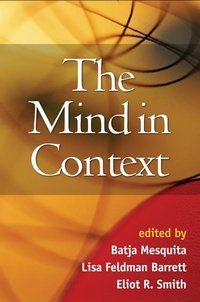
The Mind in Context
1st Edition
Published on 21. April 2010
Book
Hardback
371 pages
978-1-60623-553-9 (ISBN)
Description
Most psychology research still assumes that mental processes are internal to the person, waiting to be expressed or activated. This compelling book illustrates that a new paradigm is forming in which contextual factors are considered central to the workings of the mind. Leading experts explore how psychological processes emerge from the transactions of individuals with their physical, social, and cultural environments. The volume showcases cutting-edge research on the contextual nature of such phenomena as gene expression, brain networks, the regulation of hormones, perception, cognition, personality, knowing, learning, and emotion.
Reviews / Votes
Can you see a figure without a background? Can you understand a person without the situation? Can you appreciate a mind without seeing its world? This book says 'no' in answer to these questions, and suggests instead that the study of psychology must adopt a new maneuver--a thoroughgoing vision of mind as a contextualized and contextualizing engine. The distinguished contributors to this volume offer a new vision of mind by daring to explore it in context.--Daniel M. Wegner, PhD, Department of Psychology, Harvard UniversityThe mind is on the loose, no longer stuffed inside the skull! Read all about it in this compelling volume from leaders in the fields of social, cultural, cognitive, and personality psychology and neuropsychology. Heralding a major paradigm shift, The Mind in Context is a highly readable explanation of how the mind extends into the world and why context is an active ingredient of mind. Thoughts, emotions, attitudes, selves, identities, and personalities are not internal entities that control behavior; instead, they emerge in mutual and reciprocal relations between individuals and their environments. An excellent contribution for students of psychology at all levels and for anyone who wants to understand how and why context matters.--Hazel Rose Markus, PhD, Davis-Brack Professor in the Behavioral Sciences, Department of Psychology, Stanford University
Revolutions in thought occur when diverse investigators converge on the same insight. In The Mind in Context, a stellar group of scientists explain how phenomena from the genetic and hormonal to the social and cultural reflect processes that are embedded, embodied, and situated. Sixteen readable chapters lead to one overarching conclusion--that the mind we've been studying as a noun is probably a verb.--Gerald L. Clore, PhD, Commonwealth Professor of Psychology, University of Virginia
- Anyone interested in learning the new twists that are taking person-situation research to the next level will want to read this book. 'Personologists' will find much to explore in Walter Mischel and Yuichi Shoda's fine contribution....Highly recommended. Upper-division undergraduates through faculty and professionals. --Choice, 11/3/2010
More details
Language
English
Place of publication
New York
United States
Target group
Professional and scholarly
Professional Practice & Development
Product notice
sewn/stitched
Cloth over boards
With dust jacket
Dimensions
Height: 235 mm
Width: 164 mm
Thickness: 37 mm
Weight
639 gr
ISBN-13
978-1-60623-553-9 (9781606235539)
Copyright in bibliographic data and cover images is held by Nielsen Book Services Limited or by the publishers or by their respective licensors: all rights reserved.
Schweitzer Classification
Other editions
Additional editions
Batja Mesquita | Lisa Feldman Barrett | Eliot R. Smith
The Mind in Context
E-Book
01/2010
The Guilford Press
€69.49
Available for download
Persons
Batja Mesquita, PhD, is Professor of the Psychology of Emotion and Motivation at the Center for Cultural and Social Psychology at the University of Leuven in Belgium. Most of her research focuses on the constitutional role of cultural contexts in emotion. Dr. Mesquita has published widely on topics related to cultural differences in emotions and on acculturation and emotion. She has served as Associate Editor of Cognition and Emotion and Emotion Review and is currently on the editorial boards of Emotion, Personality and Social Psychology Bulletin, and Social and Personality Psychology Compass. Dr. Mesquita is a Fellow of the Royal Netherlands Academy of Arts and Sciences, the Association for Psychological Science, the Society for Personality and Social Psychology, the American Psychological Association, and the Society of Experimental Social Psychology.
Lisa Feldman Barrett, PhD, is University Distinguished Professor of Psychology and Director of the Interdisciplinary Affective Science Laboratory at Northeastern University, with research appointments at Harvard Medical School and Massachusetts General Hospital (MGH), and is a faculty member at the MGH Center for Law, Brain and Behavior. Dr. Barrett's research focuses on the nature of emotion from both psychological and neuroscience perspectives, and incorporates insights from anthropology, philosophy, linguistics, and the history of psychology. She is the recipient of the William James Fellow Award from the Association for Psychological Science (APS) and the Pioneer Award from the National Institutes of Health, among numerous other awards, and is a Fellow of the Royal Society of Canada, the American Association for the Advancement of Science, and the APS. She was a founding Editor-in-Chief of the journal Emotion Review and cofounder of the Society for Affective Science. Dr. Barrett has published more than 170 papers and book chapters.
Eliot R. Smith, PhD, is Classes of the War Years Chancellor's Professor of Psychological and Brain Sciences at Indiana University. His research interests include the role of emotion in prejudice and intergroup behavior, as well as socially situated cognition. Dr. Smith's research has been recognized by the Thomas M. Ostrom Award for lifetime contributions to social cognition from Indiana University, as well as the Theoretical Innovation Prize from the Society for Personality and Social Psychology. He has served as Editor of Personality and Social Psychology Review and as Associate Editor of the Journal of Personality and Social Psychology: Attitudes and Social Cognition. He is a Fellow of the Association for Psychological Science, the Society for Personality and Social Psychology, the American Psychological Association, and the Society of Experimental Social Psychology.
Lisa Feldman Barrett, PhD, is University Distinguished Professor of Psychology and Director of the Interdisciplinary Affective Science Laboratory at Northeastern University, with research appointments at Harvard Medical School and Massachusetts General Hospital (MGH), and is a faculty member at the MGH Center for Law, Brain and Behavior. Dr. Barrett's research focuses on the nature of emotion from both psychological and neuroscience perspectives, and incorporates insights from anthropology, philosophy, linguistics, and the history of psychology. She is the recipient of the William James Fellow Award from the Association for Psychological Science (APS) and the Pioneer Award from the National Institutes of Health, among numerous other awards, and is a Fellow of the Royal Society of Canada, the American Association for the Advancement of Science, and the APS. She was a founding Editor-in-Chief of the journal Emotion Review and cofounder of the Society for Affective Science. Dr. Barrett has published more than 170 papers and book chapters.
Eliot R. Smith, PhD, is Classes of the War Years Chancellor's Professor of Psychological and Brain Sciences at Indiana University. His research interests include the role of emotion in prejudice and intergroup behavior, as well as socially situated cognition. Dr. Smith's research has been recognized by the Thomas M. Ostrom Award for lifetime contributions to social cognition from Indiana University, as well as the Theoretical Innovation Prize from the Society for Personality and Social Psychology. He has served as Editor of Personality and Social Psychology Review and as Associate Editor of the Journal of Personality and Social Psychology: Attitudes and Social Cognition. He is a Fellow of the Association for Psychological Science, the Society for Personality and Social Psychology, the American Psychological Association, and the Society of Experimental Social Psychology.
Content
1. The Context Principle, Lisa Feldman Barrett, Batja Mesquita, and Eliot R. Smith
I. Genes and the Brain
2. Epigenetic Inheritance, Lawrence V. Harper
3. Brain Networks and Embodiment, Olaf Sporns
4. Social Modulation of Hormones, Sari M. van Anders
II. Cognition and Affect
5. Emoting: A Contextualized Process, Batja Mesquita
6. Meaning in Context: Meta-Cognitive Experiences, Norbert Schwarz
7. Situated Cognition, Eliot R. Smith and Elizabeth C. Collins
III. The Person
8. The Situated Person, Walter Mischel and Yuichi Shoda
9. Implicit Independence and Interdependence: A Cultural Task Analysis, Shinobu Kitayama and Toshie Imada
10. Platonic Blindness and the Challenge of Understanding Context, Yarrow Dunham and Mahzarin R. Banaji
11. Social Tuning of Ethnic Attitudes, Stacey Sinclair and Janetta Lun
IV. Behavior
12. The Multiple Forms of Context in Associative Learning Theory, Mark E. Bouton
13. Threat, Marginality, and Reactions to Norm Violations, Deborah A. Prentice and Thomas E. Trail
14. Behavior as Mind in Context: A Cultural Psychology Analysis of Paranoid Suspicion in West African Worlds, Glen Adams, Phia S. Salter, Kate M. Pickett, TugA?e Kurtis, and Nia L. Phillips
15. Challenging the Egocentric View of Coordinated Perceiving, Acting, and Knowing, Michael J. Richardson, Kerry L. Marsh, and R. C. Schmidt
16. Conclusion: On the Vices of Nominalization and the Virtues of Contextualizing, Lawrence W. Barsalou, Christine D. Wilson, and Wendy Hasenkamp
I. Genes and the Brain
2. Epigenetic Inheritance, Lawrence V. Harper
3. Brain Networks and Embodiment, Olaf Sporns
4. Social Modulation of Hormones, Sari M. van Anders
II. Cognition and Affect
5. Emoting: A Contextualized Process, Batja Mesquita
6. Meaning in Context: Meta-Cognitive Experiences, Norbert Schwarz
7. Situated Cognition, Eliot R. Smith and Elizabeth C. Collins
III. The Person
8. The Situated Person, Walter Mischel and Yuichi Shoda
9. Implicit Independence and Interdependence: A Cultural Task Analysis, Shinobu Kitayama and Toshie Imada
10. Platonic Blindness and the Challenge of Understanding Context, Yarrow Dunham and Mahzarin R. Banaji
11. Social Tuning of Ethnic Attitudes, Stacey Sinclair and Janetta Lun
IV. Behavior
12. The Multiple Forms of Context in Associative Learning Theory, Mark E. Bouton
13. Threat, Marginality, and Reactions to Norm Violations, Deborah A. Prentice and Thomas E. Trail
14. Behavior as Mind in Context: A Cultural Psychology Analysis of Paranoid Suspicion in West African Worlds, Glen Adams, Phia S. Salter, Kate M. Pickett, TugA?e Kurtis, and Nia L. Phillips
15. Challenging the Egocentric View of Coordinated Perceiving, Acting, and Knowing, Michael J. Richardson, Kerry L. Marsh, and R. C. Schmidt
16. Conclusion: On the Vices of Nominalization and the Virtues of Contextualizing, Lawrence W. Barsalou, Christine D. Wilson, and Wendy Hasenkamp