

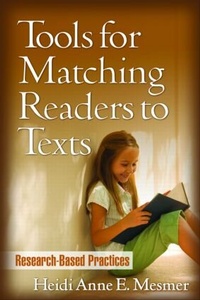
Tools for Matching Readers to Texts
Research-Based Practices
1st Edition
Published on 13. January 2009
Book
Hardback
180 pages
978-1-59385-598-7 (ISBN)
Description
Selecting reading materials at the appropriate level for each student is an essential component of promoting literacy, and a number of tools for determining text difficulty are now available. This unique, much-needed reference helps teachers choose from a wide array of approaches and implement them effectively. Provided is a thorough, integrative review of recently developed applications such as Lexiles, as well as traditional readability formulas and systems for beginning readers. Detailed vignettes clearly illustrate how teachers have used these tools in real classrooms and provide tips and pointers for success. Rich with charts, tables, and resources, this practical guide includes an appendix on two electronic book matching programs, Accelerated Reader and Reading Counts.
Reviews / Votes
Mesmer has emerged as one of the leading authorities on text features that support learning to read. In this book, she offers both a comprehensive examination of the research literature in this area and a very useful set of guidelines for the use of text analysis tools. The chapters that focus on actual school-level and classroom-level practices are particularly helpful.--James V. Hoffman, PhD, Department of Curriculum and Instruction, University of Texas at AustinMesmer has done an extraordinary job. This is one of the first books to provide a comprehensive review of information about text analysis tools, and it represents an important contribution to the literature on instructional materials. I think students in my graduate reading education courses will find this an excellent resource. In particular, the vignettes will help them understand how text analysis tools can be applied in schools.--Priscilla L. Griffith, PhD, Department of Instructional Leadership and Academic Curriculum, University of Oklahoma
Reading educators of all stripes, from classroom teachers to coaches, will find this text a valuable resource. Mesmer analyzes reading tools that are ubiquitous in classrooms but are rarely discussed with any informative depth. The book's analysis of these tools, discussion of their advantages and disadvantages, and vignettes for classroom application fill a long-standing gap in the field.--Kathleen J. Brown, PhD, Director, University of Utah Reading Clinic
-
More details
Series
Language
English
Place of publication
New York
United States
Target group
Professional and scholarly
Dimensions
Height: 229 mm
Width: 152 mm
Weight
378 gr
ISBN-13
978-1-59385-598-7 (9781593855987)
Copyright in bibliographic data and cover images is held by Nielsen Book Services Limited or by the publishers or by their respective licensors: all rights reserved.
Schweitzer Classification
Other editions
Additional editions
Book
01/2008
1st Edition
Guilford Publications
€34.00
Article not available at the moment
Person
Heidi Anne E. Mesmer, PhD, is Assistant Professor at Virginia Polytechnic Institute and State University, where she conducts research and teaches literacy courses to graduate students. She is a former elementary school teacher and has taught in both urban and rural settings. Since 1999 she has studied beginning reading materials and text difficulty. Dr. Mesmer has worked extensively with schools and teachers in funded projects. She was a Spencer Foundation/National Academy of Education postdoctoral fellow and a recipient of an Institute of Education Sciences/American Educational Research Association grant.
Content
1.Using Text Analysis Tools to Match Readers to Texts
I. Text Analysis Tools: A Reference
2. Traditional Readability Formulas
3. Second-Generation Readability Formulas: Lexiles and Degrees of Reading Power
4. Textual Scaffolds for Beginning Readers: Qualitative Leveling, Decodability, and Vocabulary Control
II. Choosing and Using Text Analysis Tools
5. Choosing Text Analysis Tools: Successful Schools
6. Using Text Analysis Tools: Successful Primary Teachers
7. Using Text Analysis Tools: Successful Intermediate Teachers
Appendix. Applications of Readability Formulas: Accelerated Reader and Reading Counts
I. Text Analysis Tools: A Reference
2. Traditional Readability Formulas
3. Second-Generation Readability Formulas: Lexiles and Degrees of Reading Power
4. Textual Scaffolds for Beginning Readers: Qualitative Leveling, Decodability, and Vocabulary Control
II. Choosing and Using Text Analysis Tools
5. Choosing Text Analysis Tools: Successful Schools
6. Using Text Analysis Tools: Successful Primary Teachers
7. Using Text Analysis Tools: Successful Intermediate Teachers
Appendix. Applications of Readability Formulas: Accelerated Reader and Reading Counts