

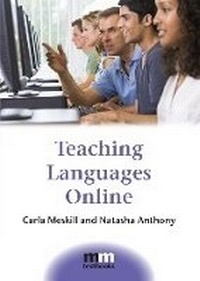
Teaching Languages Online
Published on 17. May 2010
Book
Paperback/Softback
208 pages
978-1-84769-271-9 (ISBN)
Description
Novice and experienced educators who have considered moving some or all of their language courses online will find this text an invaluable starting point and resource throughout the process. In non-technical prose with emphasis throughout on excellence in pedagogical practice, the text takes both the new and experienced language instructor through the nuts and bolts of online teaching practices and uses multiple examples of online instructional conversations to illustrate these practices. Teaching in asynchronous written, asynchronous aural, synchronous written, synchronous aural and combinations of these environments are discussed and exemplary practices provided for each. An excellent place to both begin and augment language teaching online.
Reviews / Votes
When it comes to language learning, the question is no long whether online instruction is effective, but rather how to go about creating effective learning opportunities online. This question is answered with admirable clarity by Meskill and Anthony. Through exposition and example, they demonstrate those areas of language pedagogy that are more effectively dealt with through online than face-to-face instruction. The book is a valuable addition to the growing list of books on the subject, and will be valued by experienced as well as novice online language teachers. * David Nunan, Emeritus Professor of Applied Linguistics, University of Hong Kong * This is an ideal book for language educators who value a sociocultural view of second language learning and want to teach effectively online using cutting-edge, judiciously chosen technologies and Internet resources. Meskill and Anthony have crafted an impressive set of tools for both the novice and the experienced online instructor, with many authentic examples in a number of languages, masterfully combining modalities so as to appeal to the digital native learners of the 21st century. * Dorothy Chun, University of California, Santa Barbara, USA. * With numerous example activities, extracts from student-teacher interactions, and practical suggestions for the implementation of online teaching, 'Teaching Languages Online' (Meskill and Anthony, 2010) is a valuable addition to the language teachers' book-shelf. * Zoee Handley, Department of Education, University of Oxford, UK - LINGUIST List 21.4908 * The book is a principled collection of techniques and activities that will inspire online teachers to try similar techniques in their own classrooms. In fact, the book's real strength is as a guide, or even an introduction, to language teaching techniques whether online or not. Novice language teachers who are digital natives may find this book an ideal way to learn to teach, as it frames teaching in very familiar, online ways without assuming that the teacher has taught in a traditional classroom. Expert teachers who are digital immigrants will benefit as well, as they may already know when, how, and why to do things like 'trap' learners into using particular forms, but they might not easily realize that it can be done in different, more effective ways online. -- Jonathon Reinhardt, University of Arizona in The Canadian Modern Language Review, 2012, 68, 4, 451-457More details
Series
Language
English
Place of publication
Bristol
United Kingdom
Publishing group
Channel View Publications Ltd
Target group
Professional and scholarly
Product notice
Paperback (trade)
Dimensions
Height: 241 mm
Width: 175 mm
Thickness: 15 mm
Weight
375 gr
ISBN-13
978-1-84769-271-9 (9781847692719)
Copyright in bibliographic data and cover images is held by Nielsen Book Services Limited or by the publishers or by their respective licensors: all rights reserved.
Schweitzer Classification
Other editions
Additional editions
Carla Meskill | Natasha Anthony
Teaching Languages Online
Book
05/2010
Multilingual Matters
€106.60
Article exhausted; check different version
Persons
Carla Meskill is Professor in the Department of Educational Theory and Practice at the University at Albany, State University of New York. Her research and teaching explores new forms of technology use in language education as well as the influences of new technologies on developing language and literacy practices.
Natasha Anthony is Director of the International Language Laboratory and Assistant Professor of Russian at Hudson Valley Community College in New York. She also teaches graduate online courses in the Department of Educational Theory and Practice at the University at Albany, State University of New York. Her research focuses on Computer Assisted Language Learning and, more specifically, on the use of synchronous and asynchronous oral components in online language courses.
Natasha Anthony is Director of the International Language Laboratory and Assistant Professor of Russian at Hudson Valley Community College in New York. She also teaches graduate online courses in the Department of Educational Theory and Practice at the University at Albany, State University of New York. Her research focuses on Computer Assisted Language Learning and, more specifically, on the use of synchronous and asynchronous oral components in online language courses.
Content
Chapter 1 Teaching Languages Well Online: The Essentials
Chapter 2 Language Learning and Teaching in Oral Synchronous Environments
Chapter 3 Language Learning and Teaching in Oral Asynchronous Environments
Chapter 4 Oral Venues Amplified via Text and Visuals
Chapter 5 Language Learning and Teaching in Written Synchronous Environments
Chapter 6 Language Learning and Teaching in Written Asynchronous Environments
Chapter 7 Written Venues Amplified via Sounds and Visuals
Chapter 8 Continuing the Conversation
Chapter 2 Language Learning and Teaching in Oral Synchronous Environments
Chapter 3 Language Learning and Teaching in Oral Asynchronous Environments
Chapter 4 Oral Venues Amplified via Text and Visuals
Chapter 5 Language Learning and Teaching in Written Synchronous Environments
Chapter 6 Language Learning and Teaching in Written Asynchronous Environments
Chapter 7 Written Venues Amplified via Sounds and Visuals
Chapter 8 Continuing the Conversation