

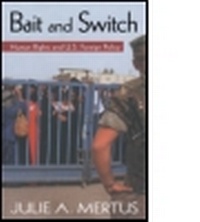
Bait and Switch
Human Rights and U.S. Foreign Policy
1st Edition
Published on 17. June 2004
Book
Paperback/Softback
280 pages
978-0-415-94851-7 (ISBN)
Description
It has become routine for the U.S. government to invoke human rights to justify its foreign policy decisions and military ventures. But this human rights talk has not been supported by a human rights walk. Policymakers consistently apply a double standard for human rights norms: one the rest of the world must observe, but which the U.S. can safely ignore.
Based on extensive interviews with leading foreign policymakers, military officials, and human rights advocates, Mertus tells the story of how America's attempts to promote human rights abroad have, paradoxically, undermined those rights in other countries. The second edition brings the story up to date, including new sections on the second half of the Bush administration and the Iraq War, and updates on Afghanistan.
The first edition of Bait and Switch won the American Political Science Association's 2005 Best Book on Human Rights.
Based on extensive interviews with leading foreign policymakers, military officials, and human rights advocates, Mertus tells the story of how America's attempts to promote human rights abroad have, paradoxically, undermined those rights in other countries. The second edition brings the story up to date, including new sections on the second half of the Bush administration and the Iraq War, and updates on Afghanistan.
The first edition of Bait and Switch won the American Political Science Association's 2005 Best Book on Human Rights.
Reviews / Votes
'Bait and Switch: Human Rights and U.S. Foreign Policy should be required reading for the human rights and policy-making community. This book's comparative vision of the different administrations' rhetoric and policy is particularly illuminating and the documentation of the growth of international human rights norms over the last decades masterful. I have seen nothing in the literature that is as broad in scope or as steeped in the mindsets of the various actors.' - Virginia M. Bouvier, United States Institute of Peace'An important guide for those who want to know why human rights matters more to America than America does to human rights.'- Robert A. Pastor, former National Security Advisor for Latin America (1977-81)
'Mertus' book stands as an important challenge for human rights advocates and theorists alike.' - Chandra Lekha Shriran, University of St. Andrews, International Affairs
'The authors do an excellent job of putting international human rights in context, discussing the dilemmas that states face in their foreign policy choices, and summarizing the available policy options states have to promote human rights abroad.' - Eric A. Heinze, The International Journal of Human Rights
More details
Language
English
Place of publication
London
United Kingdom
Publishing group
Taylor & Francis Ltd
Target group
College/higher education
Illustrations
1 s/w Abbildung, 3 s/w Tabellen
3 Tables, black and white; 1 Illustrations, black and white
Dimensions
Height: 229 mm
Width: 152 mm
Weight
386 gr
ISBN-13
978-0-415-94851-7 (9780415948517)
Copyright in bibliographic data and cover images is held by Nielsen Book Services Limited or by the publishers or by their respective licensors: all rights reserved.
Schweitzer Classification
Other editions
New editions
Book
02/2008
2nd Edition
Routledge
€63.80
Shipment within 15-20 days
Additional editions
Book
06/2004
1st Edition
Routledge
€163.42
Article exhausted; check for reprint
Person
Julie A. Mertus is a professor of human rights at American University and co-director of the Ethics, Peace and Global Affairs Program. She has been a Senior Fellow at the U.S. Institute of Peace, a fellow in human rights at Harvard Law School, a MacArthur Foundation Fellow, a Fulbright Fellow and a Counsel to Human Rights Watch. She is the author of five books, including Kosovo: How Myths and Truths Started a War.
Content
1. All that Glitters... 2. The Lingua Franca of Diplomacy? Human rights and the post-Cold War presidencies 3. The New Military Humanism? Human rights and the US military 4. Raising Expectations? Civil society's influence on human rights and US foreign policy 5. Conclusion: Bait and Switch? Endnotes List of Interviews Bibliography Index