

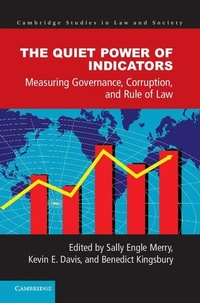
The Quiet Power of Indicators
Measuring Governance, Corruption, and Rule of Law
Published on 26. May 2015
Book
Hardback
374 pages
978-1-107-07520-7 (ISBN)
Description
Using a power-knowledge framework, this volume critically investigates how major global indicators of legal governance are produced, disseminated and used, and to what effect. Original case studies include Freedom House's Freedom in the World indicator, the Global Reporting Initiative's structure for measuring and reporting on corporate social responsibility, the World Justice Project's measurement of the rule of law, the World Bank's Doing Business index, the World Bank-supported Worldwide Governance Indicators, the World Bank's Country Performance Institutional Assessment (CPIA), and the Transparency International Corruption (Perceptions) index. Also examined is the use of performance indicators by the European Union for accession countries and by the US Millennium Challenge Corporation in allocating US aid funds.
More details
Series
Language
English
Place of publication
Cambridge
United Kingdom
Target group
College/higher education
Illustrations
9 Tables, unspecified; 8 Halftones, unspecified
Dimensions
Height: 235 mm
Width: 157 mm
Thickness: 25 mm
Weight
692 gr
ISBN-13
978-1-107-07520-7 (9781107075207)
Copyright in bibliographic data and cover images is held by Nielsen Book Services Limited or by the publishers or by their respective licensors: all rights reserved.
Schweitzer Classification
Other editions
Additional editions
Sally Engle Merry | Kevin E. Davis | Benedict Kingsbury
The Quiet Power of Indicators
Measuring Governance, Corruption, and Rule of Law
Book
05/2015
Cambridge University Press
€49.70
Shipment within 15-20 days
E-Book
05/2015
Cambridge University Press
€24.49
Available for download
Sally Engle Merry | Kevin E. Davis | Benedict Kingsbury
The Quiet Power of Indicators
Measuring Governance, Corruption, and Rule of Law
E-Book
05/2015
Cambridge University Press
€27.99
Available for download
Persons
Sally Engle Merry is Silver Professor of Anthropology at New York University. She is the author and editor of nine books, including the J. Willard Hurst Prize-winning Colonizing Hawai'i: The Cultural Power of Law (2000). Her most recent book is Governance by Indicators (2012, co-edited with Kevin Davis, Angelina Fisher and Benedict Kingsbury). Kevin E. Davis is Beller Family Professor of Business Law and Vice Dean at New York University School of Law. He has written extensively about anti-corruption law as well as the relationship between law and economic development in such journals as the American Journal of Comparative Law, the Law and Society Review, and the New York University Law Review. Benedict Kingsbury is Murry and Ida Becker Professor of Law and director of the Institute for International Law and Justice at New York University School of Law. In addition to being co-Editor-in-Chief of the American Journal of International Law he is the editor and co-editor of over fifteen books, including International Financial Institutions and Global Legal Governance (2011).
Content
Introduction: the local-global life of indicators: law, power and resistance Kevin Davis, Benedict Kingsbury and Sally Engle Merry; Part I. Global Indicators of Governance, Corruption, and Rule of Law: 1. International organizations and the production of indicators: the case of freedom house Christopher G. Bradley; 2. Indicators and the law: a case study of the rule of law index Rene Uruena; 3. Measuring corporate accountability through global indicators Galit A. Sarfaty; 4. The quest for measuring development: the role of the indicator bank Maria Angelica Prada Uribe; 5. Qualitative and quantitative conditionality: accountability in the EU accession and MCC processes Nikhil Dutta; Part II. Indicators in Local Contexts: 6. Rule of law indicators as a political technology of power in Romania Mihaela Serban; 7. Indicators, global expertise, and a local political drama: producing and deploying corruption perception data in postsocialist Albania Smoki Musaraj; 8. Evaluating the impact of corruption (perception) indicators on governance discourses in Kenya Migai Akech; 9. Measuring labour market efficiency: indicators that fuel an ideological war and undermine social concern and trust in the South African regulatory process Debbie Collier and Paul Benjamin; Conclusion: contesting global indicators David Nelken.