

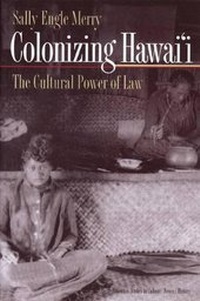
Colonizing Hawai'i
The Cultural Power of Law
Published on 30. January 2000
Book
Hardback
364 pages
978-0-691-00931-5 (ISBN)
Description
How does law transform family, sexuality, and community in the fractured social world characteristic of the colonizing process? The law was a cornerstone of the so-called civilizing process of nineteenth-century colonialism. It was simultaneously a means of transformation and a marker of the seductive idea of civilization. Sally Engle Merry reveals how, in Hawai'i, indigenous Hawaiian law was displaced by a transplanted Anglo-American law as global movements of capitalism, Christianity, and imperialism swept across the islands. The new law brought novel systems of courts, prisons, and conceptions of discipline and dramatically changed the marriage patterns, work lives, and sexual conduct of the indigenous people of Hawai'i.
Reviews / Votes
"Winner of the 2002 Williard Hurst Prize in Legal History"More details
Series
Language
English
Place of publication
New Jersey
United States
Target group
College/higher education
Professional and scholarly
Product notice
Trade binding
Illustrations
1 Maps
Dimensions
Height: 229 mm
Width: 152 mm
Weight
851 gr
ISBN-13
978-0-691-00931-5 (9780691009315)
Copyright in bibliographic data and cover images is held by Nielsen Book Services Limited or by the publishers or by their respective licensors: all rights reserved.
Schweitzer Classification
Other editions
Additional editions
E-Book
12/2020
1st Edition
Princeton University Press
€51.99
Available for download
Person
Sally Engle Merry is Class of 1949 Professor of Ethics in the Anthropology Department at Wellesley College. Her books include Urban Danger: Life in a Neighborhood of Strangers, Getting Justice and Getting Even: Legal Consciousness among Working-Class Americans, and The Possibility of Popular Justice: A Case Study of American Community Mediation, coedited with Neal Milner. She is currently president of the Association for Political and Legal Anthropology.