

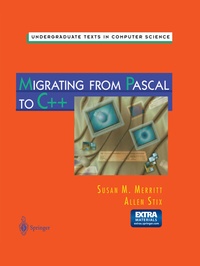
Migrating from Pascal to C++
Published on 20. December 1996
Book
Hardback
X, 565 pages
978-0-387-94730-3 (ISBN)
Description
Many students and programmers familiar with Pascal are now looking to upgrade their skills to a well-structured object-oriented programming language such as C++. This textbook provides such an "upgrade path" by presenting a course on C++ in the spirit of structured programming. Both authors teach this material to a wide variety of students and include numerous programming exercises to test a reader's understanding and to increase their confidence in programming in C++.
More details
Series
Edition
1997 ed.
Language
English
Place of publication
New York
United States
Target group
Lower undergraduate
Illustrations
X, 565 p.
Dimensions
Height: 236 mm
Width: 205 mm
Thickness: 36 mm
Weight
1296 gr
ISBN-13
978-0-387-94730-3 (9780387947303)
DOI
10.1007/978-1-4612-1902-6
Schweitzer Classification
Other editions
Additional editions
Susan N. Merritt | Allen Stix
Migrating from Pascal to C++
Book
04/2013
Springer
€53.49
Shipment within 15-20 days
Susan N. Merritt | Allen Stix
Migrating from Pascal to C++
E-Book
12/2012
Springer
€53.49
Available for download
Content
1-C++ as Structured Programming: An Historical Perspective.- 1.0 Introduction.- 1.1 Structured Programming.- 1.2 Algorithms + Data Structures = Objects.- 1.3 Programming Paradigms.- References.- 2-The C++ Subset That Covers Pascal.- 2.0 Introduction.- 2.1 Orientation to C++.- 2.2 Data Types and Data Structures.- 2.3 Arithmetic, Boolean, and Logical Expressions.- 2.4 Control Structures.- 2.5 Functions.- 2.6 Dynamically Allocated Structures.- 2.7 Output and Input.- 2.8 Summary and Review.- References.- 3-Procedural C++ That Extends Pascal.- 3.0 Introduction.- 3.1 Operators.- 3.2 Pointers.- 3.3 Extending Functions.- 3.4 Summaries.- References.- 4-C++ and Object-Oriented Programming.- 4.0 Introduction.- 4.1 Classes and Objects.- 4.2 Constructors and Destructors.- 4.3 Manipulating Abstractions: Friends and Operator Overloading.- 4.4 Relationships Among Classes: Composition and Derivation.- References.- 5-Templates.- 5.0 Introduction.- 5.1 Function Templates.- 5.2 Class Templates.- Reference.- Exercises.- 1.- 2.- 3.- 4.- 5.- Answers to Odd-Numbered Exercises.- 1.- 2.- 3.- 4.- 5.