

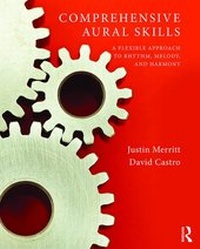
Comprehensive Aural Skills
A Flexible Approach to Rhythm, Melody, and Harmony
1st Edition
Published on 14. December 2015
Book
Paperback/Softback
384 pages
978-1-138-90071-4 (ISBN)
Description
Comprehensive Aural Skills is a complete suite of material for both performance and dictation, covering the wide range of sight singing and ear training skills required for undergraduate courses of study. It provides a series of instructional modules on rhythm, melody, and harmony, and blends musical examples from the common-practice repertory with original examples composed to specifically address particular skills and concepts. Each module includes material for classroom performance, self-directed study, and homework assignments.
Features
A complete suite of aural skills material: Comprehensive Aural Skills is a combined sight singing and ear training textbook, audio, and companion website package.
Fully modular, customizable organization: Instructors can choose freely from the set of exercises in the book and supplemental material on the companion website to appropriately tailor the curriculum based on their students' needs.
Engaging and idiomatic musical examples: Examples are selected and composed specifically for the didactic context of an aural skills classroom.
Dictation exercises for practice and assignment: Practice exercises include an answer key so students can work independently and receive immediate feedback, while homework assignments are given without a key.
Audio examples for dictation: The website hosts live recordings of acoustic instruments performed by professional musicians for each dictation exercise and homework assignment.
Supplemental Materials for Instructors: A wealth of material for class use and assignment can be found on the companion website.
Teachers Guide: The guide includes answers for every homework assignment, brief commentary on each module's content, tips for integrating written theory, and strategies on how to effectively teach new concepts and skills.
The companion website for Comprehensive Aural Skills includes a wealth of additional examples in all areas of aural skills and at every level of difficulty represented in the text. Students have access to additional dictation examples with recordings and answer keys, allowing them to directly reinforce their classroom experience and practice dictation on their own time.
Features
A complete suite of aural skills material: Comprehensive Aural Skills is a combined sight singing and ear training textbook, audio, and companion website package.
Fully modular, customizable organization: Instructors can choose freely from the set of exercises in the book and supplemental material on the companion website to appropriately tailor the curriculum based on their students' needs.
Engaging and idiomatic musical examples: Examples are selected and composed specifically for the didactic context of an aural skills classroom.
Dictation exercises for practice and assignment: Practice exercises include an answer key so students can work independently and receive immediate feedback, while homework assignments are given without a key.
Audio examples for dictation: The website hosts live recordings of acoustic instruments performed by professional musicians for each dictation exercise and homework assignment.
Supplemental Materials for Instructors: A wealth of material for class use and assignment can be found on the companion website.
Teachers Guide: The guide includes answers for every homework assignment, brief commentary on each module's content, tips for integrating written theory, and strategies on how to effectively teach new concepts and skills.
The companion website for Comprehensive Aural Skills includes a wealth of additional examples in all areas of aural skills and at every level of difficulty represented in the text. Students have access to additional dictation examples with recordings and answer keys, allowing them to directly reinforce their classroom experience and practice dictation on their own time.
Reviews / Votes
"Comprehensive Aural Skills lives up to its name; together, the book and the companion website contain all the materials needed for an aural-skills curriculum. ... Comprehensive Aural Skills effectively combines singing and dictation activities in rhythm, melody, and harmony into a single book, and the high quality of the recordings makes Merritt and Castro's print-plus-digital package far more attractive than many automated dictation programs with low-quality MIDI. The inclusion of answer keys at the back of the book also makes this a viable resource for supplemental practice or even independent study ... nearly everything else needed for a four-semester curriculum is provided."- Samantha M. Inman, Music Theory Online, vol. 23, no. 3
More details
Language
English
Place of publication
London
United Kingdom
Publishing group
Taylor & Francis Ltd
Target group
College/higher education
Illustrations
1800 s/w Zeichnungen
1800 Line drawings, black and white
Dimensions
Height: 254 mm
Width: 203 mm
Weight
816 gr
ISBN-13
978-1-138-90071-4 (9781138900714)
Copyright in bibliographic data and cover images is held by Nielsen Book Services Limited or by the publishers or by their respective licensors: all rights reserved.
Schweitzer Classification
Other editions
New editions
Justin Merritt | David Castro
Comprehensive Aural Skills
A Flexible Approach to Rhythm, Melody, and Harmony
Book
03/2020
2nd Edition
Routledge
€166.50
Shipment within 15-20 days
Additional editions
Justin Merritt | David Castro
Comprehensive Aural Skills
A Flexible Approach to Rhythm, Melody, and Harmony
Book
12/2015
1st Edition
Routledge
€193.45
Withdrawn from sale
Content
Table of Contents
Preface
Rhythm
Module 1 : Simple Meters, Duple and Quadruple
Module 2 : Rests and Ties
Module 3 : Simple Meters, Triple
Module 4 : Syncopation in Simple Meters
Module 5 : Compound Meters, Duple and Quadruple
Module 6 : Compound Meters, Triple
Module 7 : Syncopation in Compound Meters
Module 8 : Triplets, Duplets, and Hemiola
Module 9 : Compound Meters, Advanced Beat Patterns
Module 10 : Asymmetrical and Mixed Meters
Melody
Module 1 : Steps Within the Major Scale
Module 2 : Steps Within the Minor Scale
Module 3 : Skips Within the Tonic Triad (Major and Minor)
Module 4 : Skips Within the Dominant (Seventh) and vii degrees
Module 5 : Further Diatonic Skips
Module 6 : Stepwise Chromatic Tones
Module 7 : Motion to the Dominant
Module 8 : Leaps To and From Chromatic Tones
Module 9 : Modulation to Closely Related Keys
Module 10 : Advanced Chromaticism
Module 11 : Modulation to Distantly Related Keys
Module 12 : Pentatonic and Diatonic Modes
Module 13 : Other Modes
Module 14 : Sets and 12-Tone Rows
Harmony
Module 1 : I(i) and V (^1 and ^5 in the bass)
Module 2 : IV(iv), ii6( degrees6), and ii (^4 and ^2 in the bass)
Module 3 : I(i)6, vii degrees6, and V6 (^3, ^2, and ^7 in the bass)
Module 4 : V7, vii degrees7, and their inversions (^5, ^7, ^2, and ^4 in the bass)
Module 5 : The Passing 6/4, Cadential 6/4, and Pedal 6/4 (^1, ^2 and ^5 in the bass)
Module 6 : IV(iv)6, vi(VI), and iii(III) (^6, and ^3 in the bass)
Module 7 : Predominant Seventh Chords - ii(o)7, ii(o)65, and IV(iv)7
Module 8 : Applied Dominants 1 - V7/V, vii degrees7/V, and V7/III
Module 9 : Applied Dominants 2 - V7/IV(iv) and vii degrees7/iv
Module 10 : Applied Dominants 3 - V7/ii, vii degrees7/ii, V7/vi(VI), and vii degrees7/vi
Module 11 : Modulation to Closely Related Keys
Module 12 : Modal mixture
Module 13 : The Neapolitan (bII)
Module 14 : Augmented 6th Chords
Module 15 : Modulations Using vii degrees7 and The ct degrees7
Appendices
Glossary of Terms
Solmization Systems
Preface
Rhythm
Module 1 : Simple Meters, Duple and Quadruple
Module 2 : Rests and Ties
Module 3 : Simple Meters, Triple
Module 4 : Syncopation in Simple Meters
Module 5 : Compound Meters, Duple and Quadruple
Module 6 : Compound Meters, Triple
Module 7 : Syncopation in Compound Meters
Module 8 : Triplets, Duplets, and Hemiola
Module 9 : Compound Meters, Advanced Beat Patterns
Module 10 : Asymmetrical and Mixed Meters
Melody
Module 1 : Steps Within the Major Scale
Module 2 : Steps Within the Minor Scale
Module 3 : Skips Within the Tonic Triad (Major and Minor)
Module 4 : Skips Within the Dominant (Seventh) and vii degrees
Module 5 : Further Diatonic Skips
Module 6 : Stepwise Chromatic Tones
Module 7 : Motion to the Dominant
Module 8 : Leaps To and From Chromatic Tones
Module 9 : Modulation to Closely Related Keys
Module 10 : Advanced Chromaticism
Module 11 : Modulation to Distantly Related Keys
Module 12 : Pentatonic and Diatonic Modes
Module 13 : Other Modes
Module 14 : Sets and 12-Tone Rows
Harmony
Module 1 : I(i) and V (^1 and ^5 in the bass)
Module 2 : IV(iv), ii6( degrees6), and ii (^4 and ^2 in the bass)
Module 3 : I(i)6, vii degrees6, and V6 (^3, ^2, and ^7 in the bass)
Module 4 : V7, vii degrees7, and their inversions (^5, ^7, ^2, and ^4 in the bass)
Module 5 : The Passing 6/4, Cadential 6/4, and Pedal 6/4 (^1, ^2 and ^5 in the bass)
Module 6 : IV(iv)6, vi(VI), and iii(III) (^6, and ^3 in the bass)
Module 7 : Predominant Seventh Chords - ii(o)7, ii(o)65, and IV(iv)7
Module 8 : Applied Dominants 1 - V7/V, vii degrees7/V, and V7/III
Module 9 : Applied Dominants 2 - V7/IV(iv) and vii degrees7/iv
Module 10 : Applied Dominants 3 - V7/ii, vii degrees7/ii, V7/vi(VI), and vii degrees7/vi
Module 11 : Modulation to Closely Related Keys
Module 12 : Modal mixture
Module 13 : The Neapolitan (bII)
Module 14 : Augmented 6th Chords
Module 15 : Modulations Using vii degrees7 and The ct degrees7
Appendices
Glossary of Terms
Solmization Systems