

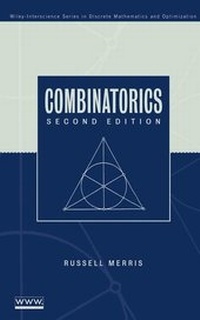
Combinatorics
2nd Edition
Published on 28. August 2003
Book
Hardback
576 pages
978-0-471-26296-1 (ISBN)
Description
mathematical gem--freshly cleaned and polished
This book is intended to be used as the text for a first course in combinatorics. the text has been shaped by two goals, namely, to make complex mathematics accessible to students with a wide range of abilities, interests, and motivations; and to create a pedagogical tool, useful to the broad spectrum of instructors who bring a variety of perspectives and expectations to such a course.
Features retained from the first edition:
* Lively and engaging writing style
* Timely and appropriate examples
* Numerous well-chosen exercises
* Flexible modular format
* Optional sections and appendices
Highlights of Second Edition enhancements:
* Smoothed and polished exposition, with a sharpened focus on key ideas
* Expanded discussion of linear codes
* New optional section on algorithms
* Greatly expanded hints and answers section
* Many new exercises and examples
Reviews / Votes
"...broad and interesting..." (Zentralblatt Math, Vol.1035, No.10, 2004) "...engagingly written...a robust learning tool..." (American Mathematical Monthly, March 2004)More details
Product info
gebunden
Series
Edition
2. Auflage
Language
English
Place of publication
United States
Publishing group
John Wiley & Sons Inc
Target group
Professional and scholarly
Edition type
New edition
Product notice
sewn/stitched
Cloth over boards
Illustrations
Charts: 4 B&W, 0 Color; Photos: 1 B&W, 0 Color; Drawings: 125 B&W, 0 Color; Tables: 41 B&W, 0 Color; Graphs: 16 B&W, 0 Color
Dimensions
Height: 240 mm
Width: 161 mm
Thickness: 35 mm
Weight
1018 gr
ISBN-13
978-0-471-26296-1 (9780471262961)
Schweitzer Classification
Other editions
Additional editions
Person
RUSSELL MERRIS, PhD, is Professor of Mathematics and Computer Science at California State University, Hayward. Among his other books is Graph Theory, also published by Wiley.
Content
Preface.
Chapter 1: The Mathematics of Choice.
1.1. The Fundamental Counting Principle.
1.2. Pascal's Triangle.
*1.3. Elementary Probability.
*1.4. Error-Correcting Codes.
1.5. Combinatorial Identities.
1.6. Four Ways to Choose.
1.7. The Binomial and Multinomial Theorems.
1.8. Partitions.
1.9. Elementary Symmetric Functions.
*1.10. Combinatorial Algorithms.
Chapter 2: The Combinatorics of Finite Functions.
2.1. Stirling Numbers of the Second Kind.
2.2. Bells, Balls, and Urns.
2.3. The Principle of Inclusion and Exclusion.
2.4. Disjoint Cycles.
2.5. Stirling Numbers of the First Kind.
Chapter 3: Pólya's Theory of Enumeration.
3.1. Function Composition.
3.2. Permutation Groups.
3.3. Burnside's Lemma.
3.4. Symmetry Groups.
3.5. Color Patterns.
3.6. Pólya's Theorem.
3.7. The Cycle Index Polynomial.
Chapter 4: Generating Functions.
4.1. Difference Sequences.
4.2. Ordinary Generating Functions.
4.3. Applications of Generating Functions.
4.4. Exponential Generating Functions.
4.5. Recursive Techniques.
Chapter 5: Enumeration in Graphs.
5.1. The Pigeonhole Principle.
*5.2. Edge Colorings and Ramsey Theory.
5.3. Chromatic Polynomials.
*5.4. Planar Graphs.
5.5. Matching Polynomials.
5.6. Oriented Graphs.
5.7. Graphic Partitions.
Chapter 6: Codes and Designs.
6.1. Linear Codes.
6.2. Decoding Algorithms.
6.3. Latin Squares.
6.4. Balanced Incomplete Block Designs.
Appendix A1: Symmetric Polynomials.
Appendix A2: Sorting Algorithms.
Appendix A3: Matrix Theory.
Bibliography.
Hints and Answers to Selected Odd-Numbered Exercises.
Index of Notation.
Index.
Note: Asterisks indicate optional sections that can be omitted without loss of continuity.