

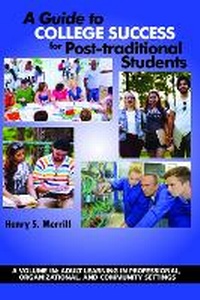
A Guide to College Success for Post-Traditional Students
Published on 22. August 2017
Book
Paperback/Softback
116 pages
978-1-68123-917-0 (ISBN)
Description
The purpose of this book is to assist post-traditional students to achieve success in the Occupational, Workforce, and Leadership Studies (OWLS) Department and develop their individualized pathway to earn the interdisciplinary Bachelor of Applied Arts and Sciences (BAAS) degree at Texas State University. Applied baccalaureate degrees incorporate higher-order thinking skills and advanced technical knowledge and skills with applied coursework. BAAS students may also earn college-level credits through prior learning assessment (PLA), evaluating and credentialing knowledge and skills gained outside the classroom. The organization and content of this book provides adult degree program faculty and leaders an example of how one required textbook develops and supports the outcomes and activities in all the core courses of an interdisciplinary degree program designed for post-traditional adult learners.
The majority of the students earning the BAAS degree are post-traditional students. They are often defined with some or all of these characteristics: over age 25 years old when starting or returning to college, may not have a traditional high school diploma, enroll part-time, work full-time, are financially independent, have dependents other than a spouse and may be a single parent. These students juggle multiple roles and responsibilities in the family, workplace, and community. Post-traditional students bring rich work/life experiences, may be experiencing personal and/or professional transitions, have clear career goals, and often finance their education. They seek flexible programs including online education, PLA, and accelerated course formats. Thus, post-traditional students want active, collaborative, and interactive learning relevant to career and other roles and goals.
The majority of the students earning the BAAS degree are post-traditional students. They are often defined with some or all of these characteristics: over age 25 years old when starting or returning to college, may not have a traditional high school diploma, enroll part-time, work full-time, are financially independent, have dependents other than a spouse and may be a single parent. These students juggle multiple roles and responsibilities in the family, workplace, and community. Post-traditional students bring rich work/life experiences, may be experiencing personal and/or professional transitions, have clear career goals, and often finance their education. They seek flexible programs including online education, PLA, and accelerated course formats. Thus, post-traditional students want active, collaborative, and interactive learning relevant to career and other roles and goals.
More details
Series
Language
English
Place of publication
Charlotte
United States
Publishing group
Emerald Publishing Inc
Target group
Professional and scholarly
Dimensions
Height: 234 mm
Width: 156 mm
Thickness: 6 mm
Weight
176 gr
ISBN-13
978-1-68123-917-0 (9781681239170)
Copyright in bibliographic data and cover images is held by Nielsen Book Services Limited or by the publishers or by their respective licensors: all rights reserved.
Schweitzer Classification
Other editions
New editions
Henry S. Merrill
A Guide to College Success for Post-traditional Students
Book
08/2018
2nd Edition
Information Age Publishing
€55.50
Shipment within 3-4 weeks
Additional editions
Henry S. Merrill
Guide to College Success for Post-traditional Students
E-Book
01/2017
1st Edition
Information Age Publishing
from
€62.33
Available for download
Content
Foreword/Acknowledgements.
Introduction.
Chapter 1. Designing a Project Plan for your Degree.
Chapter 2. Prior Learning Assessment.
Chapter 3. Useful Resources for All Courses.
Chapter 4. Official Course Descriptions for OWLS Courses Required for BAAS Degree.
Appendix A.
Appendix B.
Introduction.
Chapter 1. Designing a Project Plan for your Degree.
Chapter 2. Prior Learning Assessment.
Chapter 3. Useful Resources for All Courses.
Chapter 4. Official Course Descriptions for OWLS Courses Required for BAAS Degree.
Appendix A.
Appendix B.