

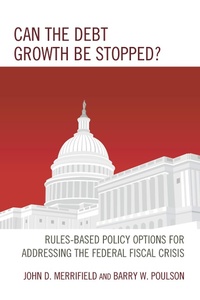
Can the Debt Growth Be Stopped?
Rules-Based Policy Options for Addressing the Federal Fiscal Crisis
Published on 11. September 2017
Book
Paperback/Softback
204 pages
978-1-4985-1811-6 (ISBN)
Description
This book explores new fiscal rules introduced in OECD countries and the relevance of fiscal rules for the unique fiscal policies and institutions in the United States. The rules in different countries are compared, with a more in depth analysis of two countries with arguably the most successful fiscal rules-Switzerland and Sweden. The study compares the challenge of fiscal consolidation facing the U.S. with that in other OECD countries. The centerpiece of the study is analysis of fiscal rules using a dynamic simulation model. A Swiss style fiscal rule is compared to an alternative fiscal rule proposed by Representative Amash, H.J.Res 24.The authors propose a new fiscal rule designed for the unique fiscal institutions in the U.S. Dynamic scoring is used to measure the impact of different fiscal rules on the federal budget, economic growth, and revenue. The effectiveness of the different fiscal rules is analyzed with respect to several criteria. A major objective of the rules is fiscal stabilization in the long run to bring debt/GDP ratios below tolerance levels. The fiscal rules are also designed for budget stabilization in the medium term, such that deficits in periods of recession are offset by surplus revenue in periods of economic expansion. The concluding section of the study explores the political economy of enacting new fiscal rules in the U.S. The study proposes fundamental changes in budget process required for the proposed fiscal rule to be effective. The study concludes with a discussion of alternative routes to enacting new fiscal rules, and the prospects for new fiscal rules to be enacted in the U.S.
Reviews / Votes
Economists Merrifield and Poulson propose adopting fiscal rules constraining growth in the federal debt. They review such rules in several OECD countries, giving particular attention to Sweden and Switzerland, which have brought austerity to their governments. The authors discuss several legislative efforts-debt ceiling, the 1974 Congressional Budget and Impoundment Control Act, the 1985 Gramm-Rudman-Hollings Balanced Budget Act, the 1990 Budget Enforcement Act, etc.-to add constraints to US finances. They propose a constitutional amendment allowing deficits in recessions to be offset by surpluses during economic expansions. The result, they say, would be a debt-to-GDP ratio declining to more comfortable levels.... Summing Up: Recommended. Graduate students and faculty. * CHOICE * Can we learn which policies promise the most sustainable path to fiscal responsibility by examining how OEDC countries responded to the debt build up during and after the great recession? Merrifield and Poulson consider this question in their interesting and insightful book, Can the Debt Growth be Stopped. -- Dwight R. Lee, Southern Methodist University Merrifield and Poulson offer substantial insight into the reasons why countries find themselves with excessive deficits and debt. By examining the successful debt control measures in Switzerland and Sweden, they provide a strong foundation for their own proposal to limit deficit spending and reduce the national debt. -- Randall G. Holcombe, DeVoe Moore Professor of Economics, Florida State UniversityMore details
Language
English
Place of publication
United States
Publishing group
Bloomsbury Publishing Plc
Target group
Professional and scholarly
Product notice
Paperback (trade)
Illustrations
11 Graphs, 10 Tables
Dimensions
Height: 230 mm
Width: 150 mm
Thickness: 11 mm
Weight
318 gr
ISBN-13
978-1-4985-1811-6 (9781498518116)
Copyright in bibliographic data and cover images is held by Nielsen Book Services Limited or by the publishers or by their respective licensors: all rights reserved.
Schweitzer Classification
Other editions
Additional editions
John Merrifield | Barry W. Poulson
Can the Debt Growth Be Stopped?
Rules-Based Policy Options for Addressing the Federal Fiscal Crisis
E-Book
03/2016
1st Edition
Lexington Books
€90.99
Available for download
Persons
John D. Merrifield is professor of economics at the University of Texas at San Antonio.
Barry W. Poulson is emeritus professor of economics at the University of Colorado.
Barry W. Poulson is emeritus professor of economics at the University of Colorado.
Content
Chapter 1 A New Era of Fiscal Rules
Chapter 2 Economic Analysis of Fiscal Rules
Chapter 3 Case Studies: Fiscal Rules in Switzerland and Sweden
Chapter 4 Fiscal Rules in the U.S.
Chapter 5 Should the U.S. Go Swiss?
Chapter 6 Designing a New Fiscal Rule for the U.S.
Chapter 7 Toward a New Budget Process
Chapter 8 The Political Economy of New Fiscal Rules
Chapter 2 Economic Analysis of Fiscal Rules
Chapter 3 Case Studies: Fiscal Rules in Switzerland and Sweden
Chapter 4 Fiscal Rules in the U.S.
Chapter 5 Should the U.S. Go Swiss?
Chapter 6 Designing a New Fiscal Rule for the U.S.
Chapter 7 Toward a New Budget Process
Chapter 8 The Political Economy of New Fiscal Rules