

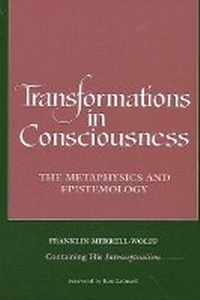
Transformations in Consciousness
The Metaphysics and Epistemology. Franklin Merrell-Wolff Containing His Introceptualism
Published on 6. July 1995
Book
Hardback
346 pages
978-0-7914-2675-3 (ISBN)
Description
This book presents a philosophy that includes the enlightenment experience--that embraces the wider ranges opened by the door of realization--while not excluding the contents of the more common experience. A realization in consciousness that finds no place or adequate recognition in philosophical systems proves the inadequacy of those systems. The author first briefly surveys the principal schools of modern Western philosophy in order to show how they fall short. He then presents his philosophy grounded on the authority of direct realization resulting from a transformation in consciousness.
More details
Language
English
Place of publication
Albany, NY
United States
Target group
Professional and scholarly
Illustrations
Total Illustrations: 0
Dimensions
Height: 229 mm
Width: 152 mm
Thickness: 25 mm
Weight
227 gr
ISBN-13
978-0-7914-2675-3 (9780791426753)
Copyright in bibliographic data and cover images is held by Nielsen Book Services Limited or by the publishers or by their respective licensors: all rights reserved.
Schweitzer Classification
Other editions
Additional editions
Franklin Merrell-Wolff
Transformations in Consciousness
The Metaphysics and Epistemology. Franklin Merrell-Wolff Containing His Introceptualism
E-Book
07/1995
State University of New York Press
€37.99
Available for download
Person
After graduate work in philosophy at Harvard, Franklin Merrell-Wolff accepted a position as professor of mathematics at Stanford. A few months later, he abandoned a promising academic career in order to facilitate his quest for a third way of knowing--a way apart from sense perception and conceptual cognition. "I found myself in sight of the limits to which our present egoistic consciousness has reached, and also had found adumbrations of another kind of consciousness where alone, it seemed, solution of the subject-object consciousness could be found." He was the author of Franklin Merrell-Wolff's Experience and Philosophy: A Personal Record of Transformation and a Discussion of Transcendental Consciousness: Containing His Philosophy of Consciousness Without an Object and His Pathways Through to Space, also published by SUNY Press.
Content
FOREWORD BY RON LEONARD
INTRODUCTION
PART I: FOUR SCHOOLS OF MODERN PHILOSOPHY
1 Toward a Synthetic Philosophy
2 Naturalism
General Naturalism
Materialism
Positivism
3 The New Realism
4 Pragmatism
Vitalism
Empiric Voluntarism
Percept and Concept
Pragmatic Science
Gnostic Realization
Idealistic Pragmatism
Test by Consequences
5 Idealism
Ideas: Plato to Kant
The Primordial Image: Jung
Reason as Nous and Logos
6 Introceptual Idealism
Freedom and Necessity
Introception and Introspection
Self and Divine Otherness
Ideas: Hegel and Schopenhauer
The Self
Unidentified Introception
The Problem of Formulation
Conception, Perception and Introception
PART II: INTROCEPTUALISM
7 Introception
The Flow of Consciousness
Introceptual Process: St. John of the Cross
Conception and the Mystic Thought
8 Transcendentalism
Conception and Introception
Innate Ideas
The Subject Transcends the Object
9 Reality and Appearance
Conceptual Presentation
Substantiality Is Inversely Proportional to Ponderability
Knowledge through Identity
10 The Meaning of Divinity
PART III: THE PSYCHOLOGICAL CRITIQUE OF MYSTICISM
11 Judgments of Meaning and Existence
12 Three Mystical Paradigms
Mysticism
The Christ
The Buddha
Shankara
Self (Atman) or No-Self (Anatman)
A Mathematical Model of Ego Metaphysics
13 Mystical Knowledge
Critique of Leuba's Methodology
The Mystic Thought
Knowledge as Negation
Shift in the Base of Reference
Leuba's Antinoetic Argument
14 Significance of Immediate Qualities of Mystical States
EPILOGUE
INDEX
INTRODUCTION
PART I: FOUR SCHOOLS OF MODERN PHILOSOPHY
1 Toward a Synthetic Philosophy
2 Naturalism
General Naturalism
Materialism
Positivism
3 The New Realism
4 Pragmatism
Vitalism
Empiric Voluntarism
Percept and Concept
Pragmatic Science
Gnostic Realization
Idealistic Pragmatism
Test by Consequences
5 Idealism
Ideas: Plato to Kant
The Primordial Image: Jung
Reason as Nous and Logos
6 Introceptual Idealism
Freedom and Necessity
Introception and Introspection
Self and Divine Otherness
Ideas: Hegel and Schopenhauer
The Self
Unidentified Introception
The Problem of Formulation
Conception, Perception and Introception
PART II: INTROCEPTUALISM
7 Introception
The Flow of Consciousness
Introceptual Process: St. John of the Cross
Conception and the Mystic Thought
8 Transcendentalism
Conception and Introception
Innate Ideas
The Subject Transcends the Object
9 Reality and Appearance
Conceptual Presentation
Substantiality Is Inversely Proportional to Ponderability
Knowledge through Identity
10 The Meaning of Divinity
PART III: THE PSYCHOLOGICAL CRITIQUE OF MYSTICISM
11 Judgments of Meaning and Existence
12 Three Mystical Paradigms
Mysticism
The Christ
The Buddha
Shankara
Self (Atman) or No-Self (Anatman)
A Mathematical Model of Ego Metaphysics
13 Mystical Knowledge
Critique of Leuba's Methodology
The Mystic Thought
Knowledge as Negation
Shift in the Base of Reference
Leuba's Antinoetic Argument
14 Significance of Immediate Qualities of Mystical States
EPILOGUE
INDEX