

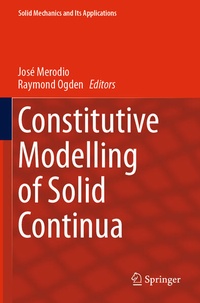
Constitutive Modelling of Solid Continua
Published on 27. November 2020
Book
Paperback/Softback
XII, 389 pages
978-3-030-31549-8 (ISBN)
Description
This volume consists of a collection of chapters by recognized experts to provide a comprehensive fundamental theoretical continuum treatment of constitutive laws used for modelling the mechanical and coupled-field properties of various types of solid materials. It covers the main types of solid material behaviour, including isotropic and anisotropic nonlinear elasticity, implicit theories, viscoelasticity, plasticity, electro- and magneto-mechanical interactions, growth, damage, thermomechanics, poroelasticity, composites and homogenization. The volume provides a general framework for research in a wide range of applications involving the deformation of solid materials. It will be of considerable benefit to both established and early career researchers concerned with fundamental theory in solid mechanics and its applications by collecting diverse material in a single volume. The readership ranges from beginning graduate students to senior researchers in academia and industry.
More details
Series
Edition
2020 ed.
Language
English
Place of publication
Cham
Switzerland
Publishing group
Springer International Publishing
Target group
Professional and scholarly
Illustrations
30 farbige Abbildungen, 14 s/w Abbildungen
XII, 389 p. 44 illus., 30 illus. in color.
Dimensions
Height: 235 mm
Width: 155 mm
Thickness: 22 mm
Weight
610 gr
ISBN-13
978-3-030-31549-8 (9783030315498)
DOI
10.1007/978-3-030-31547-4
Schweitzer Classification
Other editions
Additional editions
José Merodio | Raymond Ogden
Constitutive Modelling of Solid Continua
Book
11/2019
Springer
€160.49
Article exhausted; check for reprint
Content
Basic Continuum Mechanics and Thermomechanics.- Nonlinear Elasticity Theory.- Viscoelasticity.- Plasticity.- Magneto/Electro Interactions.- Implicit Theories.- Damage Mechanics.- Theories of Growth.- Nonlinear Homogenization.- Porosity and Diffusion.- Multiscale Modelling within Linear Homogenization.