

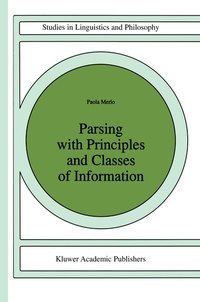
Parsing with Principles and Classes of Information
Published on 31. August 1996
Book
Hardback
X, 246 pages
978-0-7923-4103-1 (ISBN)
Description
Parsing with Principles and Classes of Information
presents a parser based on current principle-based linguistic theories for English. It argues that differences in the kind of information being computed, whether lexical, structural or syntactic, play a crucial role in the mapping from grammatical theory to parsing algorithms.
The direct encoding of homogeneous classes of information has computational and cognitive advantages, which are discussed in detail. Phrase structure is built by using a fast algorithm and compact reference tables. A quantified comparison of different compilation methods shows that lexical and structural information are most compactly represented by separate tables. This finding is reconciled to evidence on the resolution of lexical ambiguity, as an approach to the modularization of information.
The same design is applied to the efficient computation of long- distance dependencies. Incremental parsing using bottom-up tabular algorithms is discussed in detail.
Finally, locality restrictions are calculated by a parametric algorithm.
Students of linguistics, parsing and psycholinguistics will find this book a useful resource on issues related to the implementation of current linguistic theories, using computational and cognitive plausible algorithms.
The direct encoding of homogeneous classes of information has computational and cognitive advantages, which are discussed in detail. Phrase structure is built by using a fast algorithm and compact reference tables. A quantified comparison of different compilation methods shows that lexical and structural information are most compactly represented by separate tables. This finding is reconciled to evidence on the resolution of lexical ambiguity, as an approach to the modularization of information.
The same design is applied to the efficient computation of long- distance dependencies. Incremental parsing using bottom-up tabular algorithms is discussed in detail.
Finally, locality restrictions are calculated by a parametric algorithm.
Students of linguistics, parsing and psycholinguistics will find this book a useful resource on issues related to the implementation of current linguistic theories, using computational and cognitive plausible algorithms.
More details
Series
Edition
1996 ed.
Language
English
Place of publication
Dordrecht
Netherlands
Target group
Professional and scholarly
Research
Product notice
sewn/stitched
Cloth over boards
Illustrations
X, 246 p.
Dimensions
Height: 241 mm
Width: 160 mm
Thickness: 19 mm
Weight
559 gr
ISBN-13
978-0-7923-4103-1 (9780792341031)
DOI
10.1007/978-94-009-1708-8
Schweitzer Classification
Other editions
Additional editions
Book
09/2011
Springer
€106.99
Shipment within 15-20 days
Content
1 Grammars and Parsers.- 1.1 Introduction.- 1.2 On Grammar Parser Relations.- 1.3 Modularity.- 1.4 Partial Compilation Based on Information Content.- 2 Overview of the Parser.- 2.1 Introduction.- 2.2 An Example.- 2.3 Related Work.- 3 The Phrase Structure Component.- 3.1 Introduction.- 3.2 The Data Structures and The Parsing Algorithms.- 3.3 Compactness of the Data Structures.- 3.4 Psycholinguistic Support.- 4 The Computation of Syntactic Features.- 4.1 Introduction.- 4.2 The Interleaving of Constraints.- 4.3 The Assignment of Local Syntactic Features.- 4.4 Computing Long Distance Dependencies.- 4.5 Psycholinguistic Support.- 4.6 Incremental Assignment of Features.- 5 Locality.- 5.1 The Linguistic Facts.- 5.2 Related Work.- 5.3 Parameterised Subjacency.- 5.4 Implementation.- A The Computational and the Linguistic Framework: A Glossary.- A.1 Levels of Representation.- A.2 The Modules.- A.3 Parsing Algorithms.- B Results.- References.