

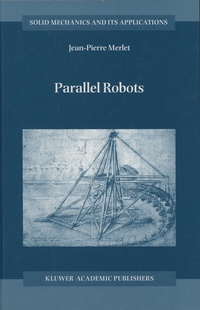
Parallel Robots
Published on 30. November 2001
Book
Paperback/Softback
XVI, 356 pages
978-1-4020-0385-1 (ISBN)
Description
Parallel robots are closed-loop mechanisms presenting very good performances in terms of accuracy, rigidity and ability to manipulate large loads. Parallel robots have been used in a large number of applications ranging from astronomy to flight simulators and are becoming increasingly popular in the field of machine-tool industry. This book presents a complete synthesis of the latest results on the possible mechanical architectures, analysis and synthesis of this type of mechanism. It is intended to be used by students (with over 100 exercises and numerous Internet addresses), researchers (with over 500 references and anonymous ftp access to the code of some algorithms presented in this book) and engineers (for which practical results and applications are presented).
More details
Series
Edition
Softcover reprint of the original 1st ed. 2000
Language
English
Place of publication
Dordrecht
Netherlands
Target group
Professional and scholarly
Research
Illustrations
XVI, 356 p.
Dimensions
Height: 23.5 cm
Width: 15.5 cm
Weight
581 gr
ISBN-13
978-1-4020-0385-1 (9781402003851)
DOI
10.1007/978-94-010-9587-7
Schweitzer Classification
Other editions
New editions
Additional editions
J.-P. Merlet
Parallel Robots
Book
01/2000
Kluwer Academic Publishers
€127.51
Article exhausted; check for reprint
Content
1 Introduction.- 1.1 Characteristics of classical robots.- 1.2 Other types of architecture.- 1.3 Needs for robotics.- 1.4 Parallel robots: definition.- 1.5 Contents.- 1.6 Exercises.- 2 Architectures.- 2.1 Introduction.- 2.2 Planar robots.- 2.3 Spatial motion robots.- 2.4 Articulated truss.- 2.5 Examples of applications.- 2.6 Notion of standard manipulators.- 2.7 Exercises.- 3 Jacobian and inverse kinematics.- 3.1 Inverse kinematics.- 3.2 Inverse jacobian matrix.- 3.3 Jacobian matrix.- 3.4 Jacobian matrix and internal sensors.- 3.5 Calibration.- 3.6 Exercises.- 4 Direct kinematics.- 4.1 Planar mechanism.- 4.2 Mechanisms for translations in space.- 4.3 Spherical mechanisms.- 4.4 6 degrees of freedom mechanisms.- 4.5 Nair systematic method.- 4.6 Case of the general robot.- 4.7 Summary of results and conclusion.- 4.8 Fast numerical methods.- 4.9 Direct kinematics with extra sensors.- 4.10 Conclusions.- 4.11 Exercises.- 5 Singular configurations.- 5.1 Introduction.- 5.2 State of the art.- 5.3 Grassmann geometry.- 5.4 Degrees of freedom associated with singularities.- 5.5 Manipulability and condition number.- 5.6 Practical search for singularities.- 5.7 Mechanisms in permanent singularity.- 5.8 Singularity-free path-planning.- 5.9 Exercises.- 6 Workspace.- 6.1 Workspace limits and representation.- 6.2 Calculation of the constant orientation workspace.- 6.3 Planar manipulator.- 6.4 6 dof manipulators.- 6.5 Trajectory checking.- 6.6 Path-planning.- 6.7 Exercises.- 7 Velocity and Acceleration.- 7.1 Relations between the articular velocities and the generalized velocities.- 7.2 Extrema of the generalized velocities.- 7.3 Extrema of the articular velocities in a translation workspace.- 7.4 Accelerations.- 7.5 Conclusion.- 7.6 Exercises.- 8 Static analysis.- 8.1 Relations between generalized and articular forces.- 8.2 Articular forces and maximal generalized forces.- 8.3 Parallel robots as force sensors.- 8.4 Stiffness and compliance.- 8.5 Extrema of the stiffnesses in a workspace.- 8.6 Balancing.- 8.7 Exercises.- 9 Dynamics.- 9.1 Introduction.- 9.2 MSSM inverse dynamics.- 9.3 SSM dynamics.- 9.4 Active wrist dynamics.- 9.5 Computation time.- 9.6 Examples.- 9.7 Exercises.- 10 Design.- 10.1 Introduction.- 10.2 Design method.- 10.3 Exercises.- 11 Conclusion.- WEB adresses.- References.