

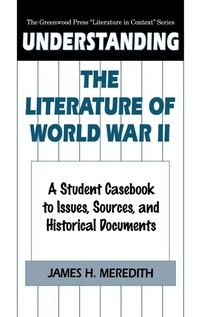
Understanding the Literature of World War II
A Student Casebook to Issues, Sources, and Historical Documents
Published on 30. June 1999
Book
Hardback
272 pages
978-0-313-30417-0 (ISBN)
Description
With insightful analysis, factual contextual information, and illuminating historical documents, this book provides a detailed, but broad perspective on the most destructive event in history. The literature analyzed in this book includes that of novelists and poets such as Joseph Heller, Norman Mailer, Irwin Shaw, Kurt Vonnegut, William Styron, Richard Wilbur, James Dickey, Paul West, and Bette Green. Along with interviews with these literary luminaries that personalize the war and help to make connections between the literature and the actual experiences of those involved, Meredith also provides rare historical documents that enhance the reader's understanding of the military and political strategies of the major forces of the war.
Each chapter provides a literary analysis of the most relevant literature for students on the topic of that chapter, followed by a historical overview of the aspect of the war that will aid the student to understand the historical context of the literature. Primary documents, especially interviews and memoirs, will help students to build bridges between history and the fictional accounts they read. Each chapter is followed by topics and questions for class discussion, suggestions for student papers, and a selected bibliography. This comprehensive casebook will be valuable for interdisciplinary study of World War II and the literature most frequently taught in high school English and history classes.
Each chapter provides a literary analysis of the most relevant literature for students on the topic of that chapter, followed by a historical overview of the aspect of the war that will aid the student to understand the historical context of the literature. Primary documents, especially interviews and memoirs, will help students to build bridges between history and the fictional accounts they read. Each chapter is followed by topics and questions for class discussion, suggestions for student papers, and a selected bibliography. This comprehensive casebook will be valuable for interdisciplinary study of World War II and the literature most frequently taught in high school English and history classes.
More details
Series
Language
English
Place of publication
United States
Publishing group
Bloomsbury Publishing Plc
Target group
College/higher education
US School Grade: From Second Grade to Twelfth Grade, Interest Age: From 14 to 17 years
Dimensions
Height: 240 mm
Width: 161 mm
Thickness: 19 mm
Weight
575 gr
ISBN-13
978-0-313-30417-0 (9780313304170)
Copyright in bibliographic data and cover images is held by Nielsen Book Services Limited or by the publishers or by their respective licensors: all rights reserved.
Schweitzer Classification
Other editions
Additional editions
James H. Meredith
Understanding the Literature of World War II
A Student Casebook to Issues, Sources, and Historical Documents
E-Book
06/1999
1st Edition
Greenwood Press
€56.49
Available for download
Person
JAMES H. MEREDITH is Associate Professor of English at the United States Air Force Academy. He is also an Associate and Book Review Editor for War, Literature and the Arts: An International Journal of the Humanities, and has served as Guest Editor as well. He has published on Ernest Hemingway, Ambrose Bierce, Stephen Crane, and war literature. He is currently working on several book-length projects, including one on Joseph Heller's fiction, which will be published in 1999.
Content
Introduction World War II Chronology The Combatants: A Literary Analysis of Martha Gellhorn's A Stricken Field, Joseph Heller's Catch-22, Kurt Vonnegut's Slaughterhouse-Five, Norman Mailer's The Naked and the Dead, James Jones' From Here to Eternity, Irwin Shaw's The Young Lions, and the poems of Richard Wilbur, James Dickey, and Randall Jarrell The Home Front: A Literary Analysis of Bette Green's Summer of My German Soldier and David Guterson's Snow Falling on Cedars Occupation, Resistance, and Espionage: A Literary Analysis of John Steinbeck's The Moon is Down, Jack Higgins' The Eagle Has Landed, and Paul West's The Very Rich Hours of Count von Stauffenberg and Rat Man of Paris The Holocaust: A Literary Analysis of William Styron's Sophie's Choice and Elie Wiesel's Night The Nuclear Bomb: A Literary Analysis of John Hersey's Hiroshima Index