


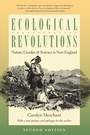
Ecological Revolutions
Nature, Gender, and Science in New England
Will be published approx. on 15. December 1989
Book
Hardback
398 pages
978-0-8078-1858-9 (ISBN)
Description
By exploring the stages of ecological transformation that took place in New England as European settlers took control of the land, Carolyn Merchant develops a fresh approach to environmental history. Her analysis of how human communities are related to their environment opens a perspective that goes beyond overt changes in the landscape.
Merchant brings to light the dense network of links between the human realm of economic regimes, social structure, and gender relations, as they are conditioned by a dominant worldview, and the ecological realm of plant and animal life. Thus we see how the integration of the Indians with their natural world was shattered by Europeans who engaged in exhaustive methods of hunting, trapping, and logging for the market and in widespread subsistence farming. The resulting ""colonial ecological revolution"" was to hold sway until roughly the time of American independence, when the onset of industrialization and increasing urbanization brought about the ""capitalist ecological revolution."" By the late nineteenth century, Merchant argues, New England had become a society that viewed the whole ecosphere as an arena for human domination. One can see in New England a ""mirror of the world,"" she says. What took place there between 1600 and 1850 was a greatly accelerated recapitulation of the evolutionary ecological changes that had occurred in Europe over a span of 2,500 years.
Merchant brings to light the dense network of links between the human realm of economic regimes, social structure, and gender relations, as they are conditioned by a dominant worldview, and the ecological realm of plant and animal life. Thus we see how the integration of the Indians with their natural world was shattered by Europeans who engaged in exhaustive methods of hunting, trapping, and logging for the market and in widespread subsistence farming. The resulting ""colonial ecological revolution"" was to hold sway until roughly the time of American independence, when the onset of industrialization and increasing urbanization brought about the ""capitalist ecological revolution."" By the late nineteenth century, Merchant argues, New England had become a society that viewed the whole ecosphere as an arena for human domination. One can see in New England a ""mirror of the world,"" she says. What took place there between 1600 and 1850 was a greatly accelerated recapitulation of the evolutionary ecological changes that had occurred in Europe over a span of 2,500 years.
More details
Series
Language
English
Place of publication
Chapel Hill
United States
Target group
College/higher education
Product notice
Cloth
Dimensions
Height: 235 mm
Width: 155 mm
ISBN-13
978-0-8078-1858-9 (9780807818589)
Copyright in bibliographic data is held by Nielsen Book Services Limited or its licensors: all rights reserved.
Schweitzer Classification
Other editions
New editions
Book
11/2010
2nd Edition
The University of North Carolina Press
€53.40
Shipment within 15-20 days