

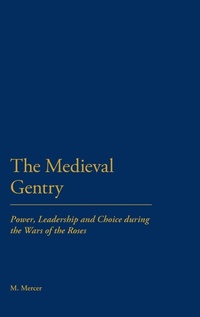
The Medieval Gentry
Power, Leadership and Choice during the Wars of the Roses
Published on 6. January 2011
Book
Hardback
184 pages
978-1-4411-9064-2 (ISBN)
Description
What were the principal factors that influenced and shaped the behaviour of the gentry during the Wars of the Roses, from 1455 at the first battle of St Albans to the final encounter at Stoke in 1487? It was the gentry who were the natural leaders within their communities and the nobility relied upon them for military manpower, and to act as their mouthpieces at local levels. Consequently, the gentry's ability to persuade their kinsmen and tenants to act in a particular way was crucial, especially their capacity to raise and lead men into battle. This was a critical factor in the outcome of the Lancastrian and Yorkist campaigns. The book begins by outlining how individuals are understood to make decisions and the discussion then moves to the late medieval gentry and the characteristics that define them as a social formation. A definition of the gentry will also be offered. The remainder of the book assesses the relationship between the gentry and the political and social world of the late middle ages.
Reviews / Votes
All readers will find new and interesting information ... thanks to a wide trawl of this good modern secondary liteature, the major printed sources and nuggets Mercer has mined in The National Archives. -- Michael Jones * The Ricardian Volume *More details
Language
English
Place of publication
New York
United States
Target group
College/higher education
Dimensions
Height: 240 mm
Width: 161 mm
Thickness: 15 mm
Weight
446 gr
ISBN-13
978-1-4411-9064-2 (9781441190642)
Copyright in bibliographic data and cover images is held by Nielsen Book Services Limited or by the publishers or by their respective licensors: all rights reserved.
Schweitzer Classification
Person
Malcolm Mercer worked at the National Archives, London from 1997 to 2006 as senior medieval records specialist, and is currently senior research archivist at Canterbury Cathedral Archives. He has researched and published widely on the late medieval gentry.
Content
Chapter 1: Introduction; Theoretical Framework; Chapter 2: Models of decision making; Chapter 3: Who were the gentry?; Motives and Behaviour; Chapter 4: Gentry, warfare, and violence; Chapter 5: Principles, public service and good lordship; Chapter 6: Practical concerns and personal circumstances; Chapter 7: Personal preferences and individual behaviour; Chapter 8: Conclusion.