

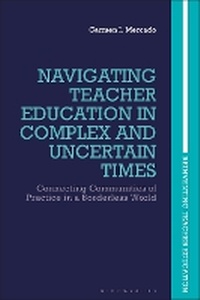
Navigating Teacher Education in Complex and Uncertain Times
Connecting Communities of Practice in a Borderless World
Published on 4. April 2019
Book
Hardback
184 pages
978-1-350-06907-7 (ISBN)
Description
Carmen I. Mercado draws on four decades of seminal research and theory on how American children, who come from homes where languages other than English are spoken, learn to read and to write in school to reveal aspects of locally-responsive planning and adaptations that should be central to any teacher education program that hopes to serve its unique, local population base responsibly.
Mercado uses a range of theoretical lenses particularly those surrounding critical theory, the approach designed to deconstruct power relationships in society, to capture and explain the complexities of the teaching-learning process making visible institutional, social and political influences clear. She explores an extensive collection of tools and resources for teaching to explore how educators can inform their thinking and shape their own practices to broaden access to people and resources, and to influence classroom instruction as school populations becomes increasingly diverse on a global scale through immigration. Mercado also shows how self-study has been a key aspect of her program's evolution, suggesting that teacher education should be informed by teacher educators' own investigations into their own programs and processes; that each teacher educator ought to be an active reinventor of her own program, based on reflection on current data.
Mercado sensitively draws together the technical and emotional dimensions of learning to teach, acknowledging that critical theory can bring up deep, often uncomfortable feelings of anger, guilt, resentment, and other responses to unfair conditions. However, since schools are designed as places of opportunity, facing these responses is essential at a time with the feelings of antagonism that characterize the present-day world and its conflictual social groups. Mercado offers the opportunity to address these facets of educational process in compelling, informed ways.
Mercado uses a range of theoretical lenses particularly those surrounding critical theory, the approach designed to deconstruct power relationships in society, to capture and explain the complexities of the teaching-learning process making visible institutional, social and political influences clear. She explores an extensive collection of tools and resources for teaching to explore how educators can inform their thinking and shape their own practices to broaden access to people and resources, and to influence classroom instruction as school populations becomes increasingly diverse on a global scale through immigration. Mercado also shows how self-study has been a key aspect of her program's evolution, suggesting that teacher education should be informed by teacher educators' own investigations into their own programs and processes; that each teacher educator ought to be an active reinventor of her own program, based on reflection on current data.
Mercado sensitively draws together the technical and emotional dimensions of learning to teach, acknowledging that critical theory can bring up deep, often uncomfortable feelings of anger, guilt, resentment, and other responses to unfair conditions. However, since schools are designed as places of opportunity, facing these responses is essential at a time with the feelings of antagonism that characterize the present-day world and its conflictual social groups. Mercado offers the opportunity to address these facets of educational process in compelling, informed ways.
Reviews / Votes
In this critical and deeply personal book, through a rich autobiographical account spanning 40 years, Mercado theorizes from her experiences as a transnational migrant teacher and teacher educator, offering powerful lessons to teachers and teacher educators alike. Urging teacher educators to push the boundaries of what is possible and embrace the ethical responsibility of problematizing standardized policies and practices, Mercado issues a much-needed call to build collective solidarity among teacher educators, positioning communities as fundamental to interrupting global and local forces working to subvert and dismantle teacher education. Navigating Teacher Education in Complex and Uncertain Times offers powerful implications for transforming teacher education collectively, within and across national boundaries. * Mariana Souto-Manning, Professor of Education, Teachers College, Columbia University, USA * Mercado thus represents the magic of learning from masterful teachers. We need more of this type of teaching to transform the lives of our students while enriching our own. * CENTRO: Journal of the Center for Puerto Rican Studies *More details
Series
Language
English
Place of publication
London
United Kingdom
Publishing group
Bloomsbury Publishing PLC
Target group
College/higher education
Illustrations
10 bw illus
Dimensions
Height: 236 mm
Width: 154 mm
Thickness: 16 mm
Weight
420 gr
ISBN-13
978-1-350-06907-7 (9781350069077)
Copyright in bibliographic data and cover images is held by Nielsen Book Services Limited or by the publishers or by their respective licensors: all rights reserved.
Schweitzer Classification
Other editions
Additional editions
Carmen I. Mercado
Navigating Teacher Education in Complex and Uncertain Times
Connecting Communities of Practice in a Borderless World
E-Book
04/2019
1st Edition
Bloomsbury Academic
€37.49
Available for download
Person
Carmen I. Mercado is Professor Emeritus at Hunter College, City University of New York, USA.
Content
Series Editors' Foreword
Part I: Beginnings
1. Introduction
2. Becoming an Educator
Part II: Learning to Teach
3. Learning to Teach Children
4. Learning to Teach Adults
Part III: Teaching to Learn in the Community
5. Challenges and Opportunities of Teaching to Learn in the Community
6. On Reimagining Educator Preparation in the Borderless Classroom
References
Index
Part I: Beginnings
1. Introduction
2. Becoming an Educator
Part II: Learning to Teach
3. Learning to Teach Children
4. Learning to Teach Adults
Part III: Teaching to Learn in the Community
5. Challenges and Opportunities of Teaching to Learn in the Community
6. On Reimagining Educator Preparation in the Borderless Classroom
References
Index