

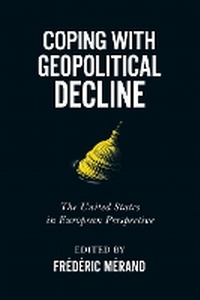
Coping with Geopolitical Decline
The United States in European Perspective
Published on 22. October 2020
Book
Hardback
344 pages
978-0-2280-0352-6 (ISBN)
Description
How great powers react to their inevitable decline shapes their own destiny as well as the course of international politics. Leaders can decide to engage with others or isolate themselves; to build alliances or initiate war; to stoke up nationalism or invest in innovation; to focus on economic competition or develop their people's soft power. While some of these coping strategies foster cooperation, others provoke conflict with neighbours. In Coping with Geopolitical Decline leading political scientists, historians, and sociologists explore the strategies adopted by leaders and domestic elites to prevent, reverse, or deny the decline of their country. Analyzing four European cases (Byzantium, England, France, Russia) before turning to the contemporary debate in the United States, they argue that geopolitics is not fate. Coping strategies depend on the context, which includes cultural representations of decline, the experience of military defeat, and domestic politics. Whether elites choose to modernize their economy, bolster their diplomatic status, or launch preventive war makes a difference in the extent and speed of a country's decline. By the same token, coping strategies affect world order. A well-managed decline allows for a peaceful power transition. Some strategies, however, may preserve the peace at the expense of a country's standing, while others will stave off decline but encourage imperialist adventures or precipitate military conflicts. As the United States challenges the liberal international order, fights back China's ascendency, and reconsiders its traditional alliances, Coping with Geopolitical Decline analyzes key lessons from Europe's experience and provides comparative insight into the likely dynamics of cooperation and conflict in the twenty-first century.
Reviews / Votes
"Coping with Geopolitical decline offers an original, significant, indeed essential contribution to recent debates in the field of historical sociology which have underlined the importance of integrating agency and the mesosociological level into a field long dominated by macrosociological approaches." Frederick Guillaume Dufour, UQAM "Coping with Geopolitical Decline is a terrific book. This is a subject that has not been fully explored, and it is marvellous that it is covered here in such an original way, with really interesting historical cases that produce conceptual innovation." John Anthony Hall, McGill University and co-author of The Paradox of Vulnerability: States, Nationalism, and the Financial CrisisMore details
Series
Language
English
Place of publication
Montreal
Canada
Target group
College/higher education
Professional and scholarly
Illustrations
7 tables, 7 photos, 2 diagrams
Dimensions
Height: 229 mm
Width: 152 mm
ISBN-13
978-0-2280-0352-6 (9780228003526)
Copyright in bibliographic data and cover images is held by Nielsen Book Services Limited or by the publishers or by their respective licensors: all rights reserved.
Schweitzer Classification
Other editions
Additional editions
E-Book
10/2020
1st Edition
McGill-Queen's University Press
€36.99
Available for download
E-Book
10/2020
1st Edition
McGill-Queen's University Press
€36.99
Available for download
Person
Frederic Merand is professor of political science and director of the Centre for International Studies at Universite de Montreal, CERIUM.