

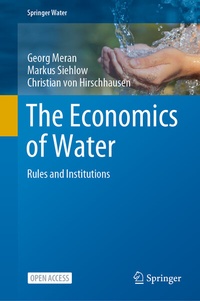
The Economics of Water
Rules and Institutions
1st Edition
Published on 5. September 2020
Book
Hardback
320 pages
978-3-030-48484-2 (ISBN)
Description
This open access textbook provides a concise introduction to economic approaches and mathematical methods for the study of water allocation and distribution problems. Written in an accessible and straightforward style, it discusses and analyzes central issues in integrated water resource management, water tariffs, water markets, and transboundary water management. By illustrating the interplay between the hydrological cycle and the rules and institutions that govern today's water allocation policies, the authors develop a modern perspective on water management. Moreover, the book presents an in-depth assessment of the political and ethical dimensions of water management and its institutional embeddedness, by discussing distribution issues and issues of the enforceability of human rights in managing water resources. Given its scope, the book will appeal to advanced undergraduate and graduate students of economics and engineering, as well as practitioners in the water sector, seeking a deeper understanding of economic approaches to the study of water management.
More details
Product info
HC runder Rücken kaschiert
Series
Edition
1st ed. 2021
Language
English
Place of publication
Cham
Switzerland
Publishing group
Springer International Publishing
Target group
Professional and scholarly
Illustrations
33 s/w Abbildungen, 36 farbige Abbildungen
36 Illustrations, color; 33 Illustrations, black and white; XVII, 301 p. 69 illus., 36 illus. in color.
Dimensions
Height: 241 mm
Width: 160 mm
Thickness: 23 mm
Weight
647 gr
ISBN-13
978-3-030-48484-2 (9783030484842)
DOI
10.1007/978-3-030-48485-9
Schweitzer Classification
Other editions
Additional editions
Georg Meran | Markus Siehlow | Christian von Hirschhausen
The Economics of Water
Rules and Institutions
Book
09/2021
1st Edition
Springer
€74.89
Shipment within 7-9 days
Persons
Georg Meran is a Professor of Environmental Economics at Technical University of Berlin (TU Berlin), Germany, and Research Fellow at the German Institute for Economic Research (DIW Berlin), Germany, specializing in applied microeconomic and institutional aspects of water. He holds a PhD from the Free University of Berlin, and has served as Dean of the DIW Berlin Graduate Center for Economic and Social Sciences (2004 - 2010), and as Dean of Studies at the Faculty of Economics and Management, Technical University of Berlin (2008 - present). Prof. Meran has published extensively on various environmental issues, allocation of water rights, pricing, nudging, energy economics, regulation issues, etc. He teaches an undergraduate course on fundamentals of environmental and resource economics, courses on advanced environmental economics as well as ecological economics, and a course on water economics, the content of which provides the basis for this textbook. Markus Siehlow is a Senior Researcher at the Workgroup of Environmental Economics at Technical University of Berlin (TU Berlin). His specialization is in the field of water economics, such as transboundary water management and industrial economics of the water sector. He works also on the field of resource, ecological and environmental economics. Together with Georg Meran, he gives courses in these economic disciplines. His PhD thesis focus on the topic of hydro-economic modeling, where methods from Operations Research are applied to the water sector. Christian von Hirschhausen is a Professor of Infrastructure Economics at Technical University of Berlin (TU Berlin), Germany, and Research Director at the German Institute for Economic Research (DIW Berlin), Germany. His research covers various infrastructure sectors, e.g., water, transportation and energy. His most recent publications have been on regulatory issues and pricing, and include a compilation on "Water - Economics and Management of a Key Resource" (DIW Berlin, 2010).
Content
Introduction.- Water Availability: A Hydrological View.- Integrated Water Resource Management: Principles and Applications.- Water Tariffs.- Water Markets.- Transboundary Water Resource Management.