

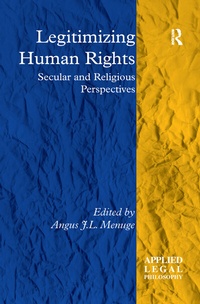
Legitimizing Human Rights
Secular and Religious Perspectives
1st Edition
Published on 30. June 2020
Book
Paperback/Softback
232 pages
978-0-367-60150-8 (ISBN)
Description
When does the exercise of an interest constitute a human right? The contributors to Menuge's edited collection offer a range of secular and religious responses to this fundamental question of the legitimacy of human rights claims. The first section evaluates the plausibility of natural and transcendent foundations for human rights. A further section explores the nature of religious freedom and the vexed question of its proper limits as it arises in the US, European, and global contexts. The final section explores the pragmatic justification of human rights: how do we motivate the recognition and enforcement of human rights in the real world? This topical book should be of interest to a range of academics from disciplines spanning law, philosophy, religion and politics.
Reviews / Votes
'Menuge has brought together a first-rate, international set of contributors to advance our reflection on the foundation, nature, and importance of human rights. This book should be studied by all those interested in human rights and who take seriously the need to inquire into the basis and justification of those rights.' Charles Taliaferro, St. Olaf College, USA 'Amongst the plethora of books on human rights, this book is remarkable. Firstly, it confronts two opposite and socially important perspectives of human rights: secular and religious. Secondly, it presents dialogues from both sides and the contributors present differing viewpoints on many issues. This is what makes the book especially exciting and I recommend it with a deep conviction.' Lech Morawski, Nicolas Copernicus University, Poland 'Since the publication of the Universal Declaration of Human Rights in 1948, human rights have been an important element in bridging cultures. But what is the foundation of human rights? Can human rights be founded within secular culture or do we need religion for that? This is a central preoccupation in this interesting and important volume.' Afshin Ellian, Leiden University, The Netherlands 'Taken together, the essays collected in Legitimizing Human Rights serve to remind atheists that if they insist on removing all traces of the law's debt to the Biblical religions, they will have also undercut the most philosophically compelling grounds for upholding the idea of human rights.' Steve Fuller, University of Warwick, UK 'One of the marks of an outstanding anthology is that its contributors confront the reader in such a way that he finds himself in an ebb and flow of dialogue, dissent, and agreement while paging through it. That's how I found myself while reading this important collection. In an age in which religious belief is not taken seriously in the rarefied corridors of the academy, this book is a welcome contribution to the literature on humMore details
Series
Language
English
Place of publication
London
United Kingdom
Publishing group
Taylor & Francis Ltd
Target group
College/higher education
Dimensions
Height: 234 mm
Width: 156 mm
Weight
453 gr
ISBN-13
978-0-367-60150-8 (9780367601508)
Copyright in bibliographic data and cover images is held by Nielsen Book Services Limited or by the publishers or by their respective licensors: all rights reserved.
Schweitzer Classification
Other editions
Additional editions
E-Book
04/2016
Routledge
€58.99
Available for download
E-Book
04/2016
Routledge
€58.99
Available for download
Book
07/2013
1st Edition
Routledge
€231.60
Shipment within 10-20 days
Person
Dr Angus Menuge is Professor and Chair of Philosophy, Concordia University, Wisconsin, USA. His teaching and research interests are in the areas of philosophy of mind, and science. He has published widely on these and related issues.
Content
Contents: Introduction, Angus J.L. Menuge; Part I The Foundation of Human Rights: Grounding human rights: naturalism's failure and Biblical theism's success, Paul Copan; Theism and human rights, Paul Cliteur; Why human rights cannot be naturalized: the contingency problem, Angus J.L. Menuge; Human rights as legal rights, Friedrich Toepel. Part II Religious Liberty and the Secular State: Human rights in a secular state will depend on its legal; definition of religion, John H. Calvert; Balancing secularism with religious freedom: in Lautsi v Italy, the European Court of Human Rights evolved, Vito Breda; Restrictions on religious freedom: when and how justified?, John Warwick Montgomery. Part III Enforcing and Motivating Human Rights: No human rights without retribution: plights and promises of redress as if nothing happened, Hendrik Kaptein; The motivation to protect and advance human rights: a faith-based approach, Dallas Miller; Why is Man the primary and functional way for the Church?: the involvement of Christian teaching in the contemporary human rights discourse, Dobrochna Bach-Golecka; Index.