

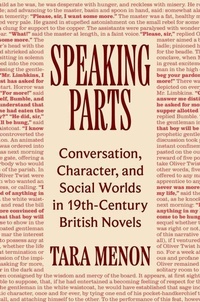
Speaking Parts
Conversation, Character, and Social Worlds in Nineteenth-Century British Novels
Will be published approx. on 8. September 2026
Book
Paperback/Softback
200 pages
978-0-691-23581-3 (ISBN)
Description
How direct speech in the novel shapes our understanding of literary characters and their social worlds
For many readers, to think of nineteenth-century fiction is to recall characters speaking: Elizabeth refusing Darcy in Pride and Prejudice; Jane excoriating Rochester in Jane Eyre; Dorothea and Celia discussing Mr. Casaubon in Middlemarch. And yet literary critics have had surprisingly little to say about the narrative effects of dialogue. In Speaking Parts, Tara Menon shows how direct speech-words enclosed in quotation marks that appear to be the exact utterances of characters-shapes our understanding of fictional characters and the social worlds they inhabit. Combining computational tools and close literary analysis, Menon reinstates direct speech to its rightful place in narrative theory, worthy of the critical seriousness afforded to such other features of narrative as free indirect discourse.
After quantifying direct speech in nearly one thousand British novels written between 1789 and 1901, Menon turns her attention to several canonical nineteenth-century works of fiction by Jane Austen, Charlotte Bronte, and George Eliot. She considers, among other things, the ways that Austen establishes sympathy for certain characters through her allotment of speech; the narrative significance of speaking characters not given proper names in Jane Eyre; and the social isolation of Dorothea in Middlemarch, as revealed by speech networks. Menon shows not only how the study of direct speech allows us to make new arguments about these well-known texts but also that data analysis of speech can change the way we think about characters, individual novels, and even genres.
For many readers, to think of nineteenth-century fiction is to recall characters speaking: Elizabeth refusing Darcy in Pride and Prejudice; Jane excoriating Rochester in Jane Eyre; Dorothea and Celia discussing Mr. Casaubon in Middlemarch. And yet literary critics have had surprisingly little to say about the narrative effects of dialogue. In Speaking Parts, Tara Menon shows how direct speech-words enclosed in quotation marks that appear to be the exact utterances of characters-shapes our understanding of fictional characters and the social worlds they inhabit. Combining computational tools and close literary analysis, Menon reinstates direct speech to its rightful place in narrative theory, worthy of the critical seriousness afforded to such other features of narrative as free indirect discourse.
After quantifying direct speech in nearly one thousand British novels written between 1789 and 1901, Menon turns her attention to several canonical nineteenth-century works of fiction by Jane Austen, Charlotte Bronte, and George Eliot. She considers, among other things, the ways that Austen establishes sympathy for certain characters through her allotment of speech; the narrative significance of speaking characters not given proper names in Jane Eyre; and the social isolation of Dorothea in Middlemarch, as revealed by speech networks. Menon shows not only how the study of direct speech allows us to make new arguments about these well-known texts but also that data analysis of speech can change the way we think about characters, individual novels, and even genres.
More details
Language
English
Place of publication
New Jersey
United States
Target group
College/higher education
Professional and scholarly
Product notice
Paperback (trade)
Illustrations
18 b/w illus.
Dimensions
Height: 235 mm
Width: 156 mm
ISBN-13
978-0-691-23581-3 (9780691235813)
Copyright in bibliographic data and cover images is held by Nielsen Book Services Limited or by the publishers or by their respective licensors: all rights reserved.
Schweitzer Classification
Person
Tara Menon is assistant professor of English at Harvard University. She is the author of the novel Under Water.