

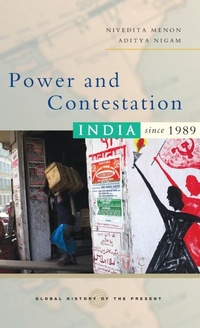
Power and Contestation
India since 1989
Published on 1. October 2007
Book
Hardback
240 pages
978-1-84277-814-2 (ISBN)
Description
1989 marks the unraveling of India's 'Nehruvian Consensus' around the idea of a modern, secular nation with a self-reliant economy.
Caste and religion have come to play major roles in national politics. Global economic integration has led to conflict between the state and dispossessed people, but processes of globalization have also enabled new spaces for political assertion, such as around sexuality. Older challenges to the idea of India continue from movements in Kashmir and the North-East, while Maoist insurgency has deepened its bases. In a world of American Empire, India as a nuclear power has abandoned non-alignment, a shift that is contested by voices within.
Power and Contestation shows that the turbulence and turmoil of this period are signs of India's continued vibrancy and democracy. The book is an ideal introduction to the complex internal histories and external power relations of a major global player for the new century.
Caste and religion have come to play major roles in national politics. Global economic integration has led to conflict between the state and dispossessed people, but processes of globalization have also enabled new spaces for political assertion, such as around sexuality. Older challenges to the idea of India continue from movements in Kashmir and the North-East, while Maoist insurgency has deepened its bases. In a world of American Empire, India as a nuclear power has abandoned non-alignment, a shift that is contested by voices within.
Power and Contestation shows that the turbulence and turmoil of this period are signs of India's continued vibrancy and democracy. The book is an ideal introduction to the complex internal histories and external power relations of a major global player for the new century.
Reviews / Votes
'This is a sophisticated yet accessible survey of contemporary Indian politics and society. It will be an excellent textbook and a handy reference work to a complex field of study'Faisal Devji, New School University
'This book approaches the daunting task of analyzing the contradictory, diverse, and divergent history of India since 1989 with uncommon intelligence. To its great merit, Power and Contestation addresses the multiple trends in Indian politics while also offering a coherent and sustained argument about the principal driving forces. To manage to accomplish all this while maintaining a perspective at once local and global is no mean feat.'
Gyan Prakash, Princeton University
'Menon and Nigam provide us a much-needed, readily accessible, deeply informed, and critically sophisticated insiders' analysis of political reality in India during its rapid rise to global stardom as a neo-liberal icon of economic success.'
David Ludden, New York University
'This book, written by two academics who are also campaigners, offers the best survey of recent Indian history that I have seen.'
Barry Pavier, International Socialism
'A great introduction to the complex contradictions that make up contemporary India .. A critical, insightful, and yet accessible description of India's present history ... Brilliant analysis ... A forceful book.'
Labour/Le Travail
More details
Series
Language
English
Place of publication
United Kingdom
Publishing group
Bloomsbury Publishing PLC
Target group
College/higher education
Professional and scholarly
Dimensions
Height: 222 mm
Width: 145 mm
Thickness: 16 mm
Weight
431 gr
ISBN-13
978-1-84277-814-2 (9781842778142)
Copyright in bibliographic data and cover images is held by Nielsen Book Services Limited or by the publishers or by their respective licensors: all rights reserved.
Schweitzer Classification
Other editions
Additional editions
E-Book
02/2008
1st Edition
Zed Books Ltd
€39.99
Available for download
Persons
Nivedita Menon is Reader in the Department of Political Science at the University of Delhi . She is author of Recovering Subversion: Feminist Politics Beyond the Law (2004) and editor of Gender and Politics in India (1999). A feminist scholar and political theorist, she has been involved in a wide range of political and social movements, especially against the rise of sectarian politics, against mass displacement of workers and in the anti-nuclearization movement.
Aditya Nigam is currently a Fellow at the Centre for the Study of Developing Societies in Delhi. He has written and published on issues relating to Marxism, modernity, nationalism and identity, and is currently working on a book on the left in a post-utopian world. He is author of The Insurrection of Little Selves (2006). He was a full-time political activist with the Communist Party of India (Marxist) for over a decade and has worked with various social movements before reentering academia.
Aditya Nigam is currently a Fellow at the Centre for the Study of Developing Societies in Delhi. He has written and published on issues relating to Marxism, modernity, nationalism and identity, and is currently working on a book on the left in a post-utopian world. He is author of The Insurrection of Little Selves (2006). He was a full-time political activist with the Communist Party of India (Marxist) for over a decade and has worked with various social movements before reentering academia.
Content
1. Introduction: The Conjuncture of the 1990s
2. Revolt of the Lower Castes
3. Hindutva: Politics of the Hindu Right
4. Nation Under Siege
5. Globalization I: Accelerated Development
6. Globalization II: The New Economy of Desire
7. Left and the Social Movements: Looking Towards the Future
8. India in the World
2. Revolt of the Lower Castes
3. Hindutva: Politics of the Hindu Right
4. Nation Under Siege
5. Globalization I: Accelerated Development
6. Globalization II: The New Economy of Desire
7. Left and the Social Movements: Looking Towards the Future
8. India in the World